
Latest News
Meat Import Compliance for Global Pork Buyers

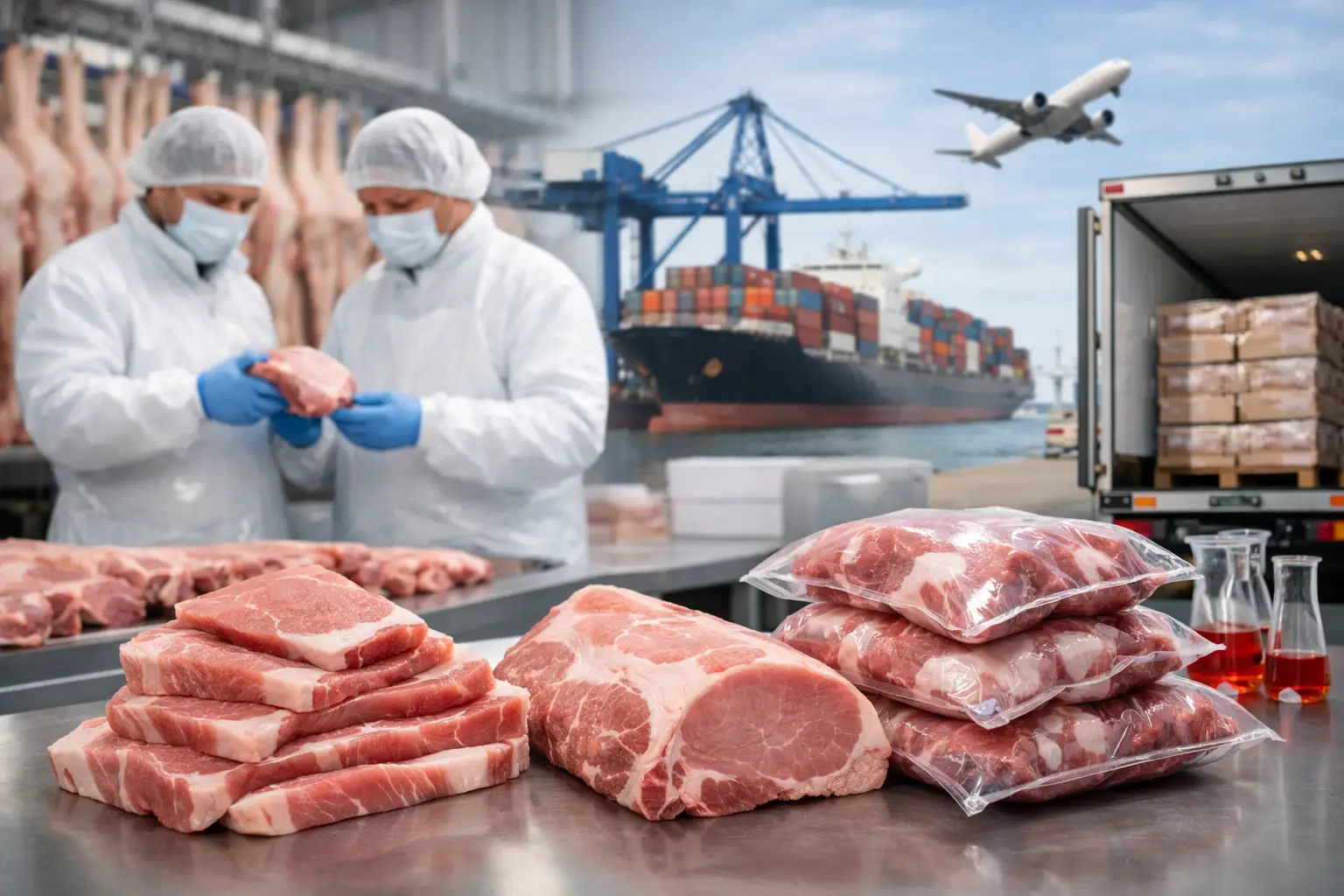
A pork shipment can meet product specifications, leave the processing plant on time, and still be delayed or rejected at destination because one document, label element, or establishment approval does not match the importing market’s requirements. Meat import compliance is therefore not a final administrative check. For international pork buyers, it is a purchasing discipline that must be built into supplier approval, product definition, production planning, and logistics.
The requirements vary by destination, product type, and intended use. Fresh chilled pork, frozen cuts, edible offal, and raw materials for further processing may follow different rules even when they travel in the same supply chain. A reliable import program begins by confirming the market conditions before an order is produced and dispatched.
Meat Import Compliance Starts Before Production
Import compliance is shared across the supply chain, but the importer remains responsible for understanding the rules that apply in the destination market. The exporting producer must be able to prepare eligible product, maintain food safety controls, preserve traceability, and issue the documentation required for the shipment. Freight forwarders and customs brokers support clearance, but they cannot correct a product that was not eligible from the start.
The first question is whether the origin country and the specific production establishment are approved for the intended destination. Market access is not universal. Authorities can apply country-specific, region-specific, species-specific, or plant-specific conditions. Approval can also depend on the product category, such as chilled pork, frozen pork, mechanically separated meat, or particular offal items.
Buyers should confirm eligibility at the stock-keeping-unit level rather than rely on a general statement that a supplier exports internationally. The exact cut, packaging format, storage condition, and processing status can affect admissibility. This is particularly relevant when sourcing mixed loads containing primal cuts, retail-ready products, and variety meats.
A practical pre-production review should establish the importing market, approved establishment, product description, tariff classification, required veterinary certification, labeling language, and shipment temperature. When these details are agreed early, the supplier can align production records and shipping documents with the order.
Product Specifications Must Match Official Documents
Border inspections often identify inconsistencies rather than obvious food safety failures. The product description on the commercial invoice, packing list, health certificate, carton label, and customs declaration should describe the same goods in terms that authorities can recognize.
For pork, the specification should clearly define the anatomical cut or offal item, whether it is bone-in or boneless, fresh or frozen, vacuum packed or bulk packed, and intended for further processing or direct distribution. Weight ranges, carton counts, batch references, and production dates should also be controlled across the document set.
Trade names can create avoidable uncertainty. A commercial name that is understood by a buyer may not correspond to the terminology required by a veterinary authority or customs classification. The safer approach is to use a precise technical description in official records and retain commercial terminology as a secondary reference where appropriate.
Product classification deserves the same attention. Customs codes determine duties, quota treatment, statistical reporting, and in some markets, additional import controls. Classification should be reviewed by the importer or qualified customs advisor before contracting, especially for offal, prepared products, and goods with different levels of processing.
Health Certificates and Supporting Records
For many markets, an official veterinary health certificate is the central document in a pork import shipment. Its format, wording, signatures, stamps, and validity conditions are determined by the destination authority. Certificates may confirm origin, animal health status, slaughter and processing conditions, inspection arrangements, storage temperatures, and compliance with destination-specific sanitary requirements.
The certificate must match the physical consignment exactly. Differences in consignee details, container number, seal number, product quantity, production establishment, or dispatch dates can trigger a hold. Corrections are not always accepted once goods have arrived, particularly when an original certificate is required at the border.
Importers should agree a document-control process with their supplier before the first shipment. This normally includes a draft review for critical fields, confirmation of the final shipment data, and a method for transmitting copies early enough for customs preparation. The purpose is not to add paperwork. It is to identify discrepancies while they can still be resolved at origin.
Supporting records are equally valuable when authorities request further evidence. These may include commercial invoices, packing lists, bills of lading, certificates of origin where relevant, temperature records, production records, and laboratory documentation. The required set depends on the market, but organized records make a border inquiry easier to manage.
Labeling and Packaging Are Compliance Controls
Carton labels are a practical link between the physical product and its traceability records. At a minimum, import requirements commonly address the product identity, country of origin, establishment identification, lot or batch reference, production or packing date, storage conditions, net weight, and destination-market language requirements.
Requirements can differ between outer cartons, inner packs, and retail packaging. A bulk carton intended for a food manufacturer may be subject to different labeling rules than a retail pack supplied to a supermarket. Buyers should specify the final channel and use of the product, because relabeling after arrival may be restricted, costly, or impractical.
Packaging must also protect product integrity throughout transport and inspection. For frozen pork, packaging performance is closely connected to temperature control, moisture management, and prevention of damage during handling. For chilled pork, shelf-life planning, dispatch timing, and destination clearance time become more sensitive. The appropriate format depends on transit duration, local distribution capability, and the buyer’s production schedule.
Cold Chain and Traceability Need to Work Together
A compliant shipment is not only correctly documented. It must remain within the required temperature range from dispatch to delivery. This involves pre-cooling, loading discipline, refrigerated container settings, seal control, transit monitoring, port handling, and receiving procedures.
Temperature data should be treated as operational evidence, not merely as a logistics report. If a deviation occurs, the buyer and supplier need a defined process to assess the cause, duration, affected lots, and product disposition. The response may differ between a brief documented variation with no product impact and a sustained failure that compromises safety or shelf life.
Traceability provides the basis for that assessment. A capable system connects animals or raw material inputs, slaughter or processing dates, cutting and packing batches, carton codes, storage locations, and shipment documents. It should enable a supplier to identify the scope of an issue quickly and allow the importer to isolate affected inventory without disrupting unrelated stock.
For high-volume procurement, traceability should be tested, not assumed. Buyers can ask how long it takes to trace a shipment back to its production batch and whether the supplier can distinguish among cartons, pallets, containers, and production dates. This is especially relevant for buyers who supply multiple customers or operate further-processing facilities.
Build Compliance Into Supplier Qualification
A supplier review should go beyond price, cut yield, and available volume. The buyer should assess whether the producer has established quality systems, controlled processing conditions, export documentation experience, and the operational capacity to maintain consistency across repeated shipments.
For Spanish pork sourcing, industrial integration can reduce handoffs between slaughter, cutting, packaging, cold storage, quality control, and export dispatch. Litera Meat operates an integrated pork-processing platform in Binéfar, Spain, with in-house laboratory capability, full-process traceability, and processing capacity of 160,000 pigs per week. For a buyer, the relevant value of this structure is control over critical information and product handling across the production chain.
The right supplier relationship also includes a clear escalation path. When an authority changes a certificate model, requests additional declarations, or introduces new labeling conditions, commercial, quality, and export teams need to respond in a coordinated way. Procurement teams should know who owns each action and how quickly documentation questions can be answered.
Practical Controls for Every Shipment
Before loading, verify that the establishment and product are eligible for the destination, the agreed specification matches official terminology, and carton labels reflect the final import requirements. Confirm that the health certificate will use the correct current format and that shipment details, including container and seal information, can be validated before issuance.
Before arrival, provide the importer with document copies early enough to prepare the customs entry and any required prior notifications. Confirm port inspection arrangements, cold-store capacity, and procedures for handling a hold. On receipt, inspect seals, carton condition, temperatures, quantities, and lot identifiers before product is released into inventory.
These controls require coordination, but they reduce the more expensive alternative: product sitting at port while teams search for a missing declaration or reconcile conflicting batch details. In international pork trade, the most dependable shipments are those planned with compliance requirements as carefully as product specifications and delivery dates.
See the products we supply, or get in touch with your requirements.