
Latest News
Meat Supplier Evaluation Criteria for B2B Buyers

A pork specification can look correct on paper and still create a serious commercial problem. A shipment may meet the agreed cut description but arrive with inconsistent weights, incomplete documentation, a shortened shelf-life window, or a delay that affects production planning. Effective meat supplier evaluation criteria therefore examine the full operating system behind the product, not only the quoted price or a sample received before approval.
For importers, distributors, food manufacturers, and retail purchasing teams, supplier selection is a risk-management decision. The right partner must consistently convert livestock, processing capacity, cold-chain control, and export documentation into product that meets the agreed specification at the required volume and delivery schedule.
Start With the Product and Market Requirement
Evaluation should begin with a precise description of what the buying business needs. “Fresh pork” is too broad for a meaningful comparison. Define the required cuts or offal, trim level, weight range, packaging format, temperature condition, shelf-life expectation, labeling language, pallet configuration, and expected annual or monthly volume.
Market requirements also change the evaluation. A distributor supplying foodservice may prioritize standardized case weights and dependable replenishment. A processor may focus on fat-to-lean consistency, technical yield, and supply continuity for a production line. An importer serving a regulated export market must place equal weight on establishment approval, veterinary documentation, labeling, and the supplier’s experience with destination-country procedures.
This initial work makes proposals comparable. It also reveals whether a supplier understands the operational purpose of each specification or simply offers a generic product catalog.
Meat Supplier Evaluation Criteria That Matter Most
Food safety and quality control
Food safety is the first condition for any commercial relationship. Buyers should understand how the supplier controls hazards from receiving through slaughter, cutting, packaging, storage, and dispatch. The key question is not whether a quality policy exists, but how it is applied at critical points in daily production.
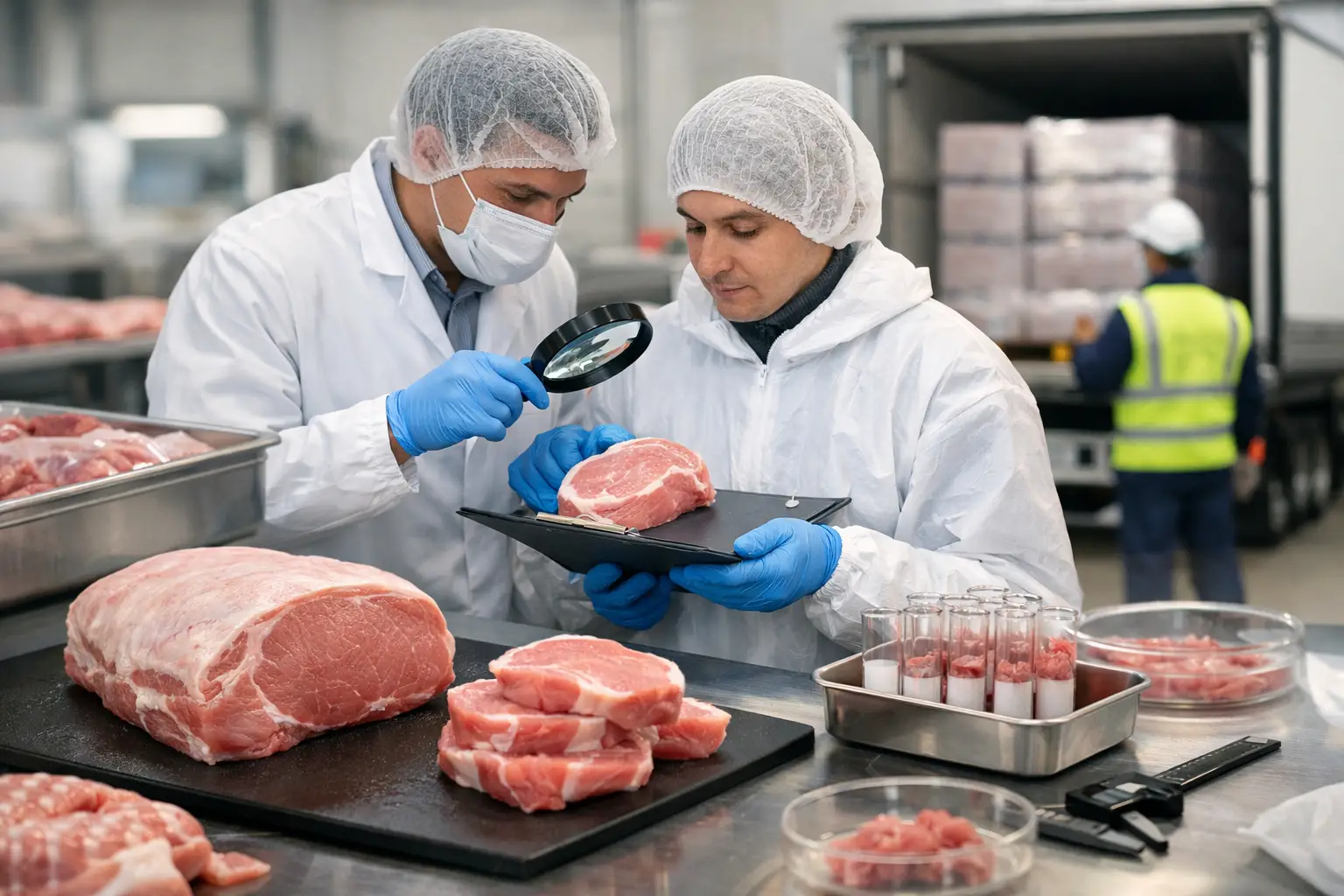
Ask how product temperatures are monitored, how sanitation is verified, how non-conforming product is isolated, and how corrective actions are documented. A supplier should be able to explain its sampling plans, laboratory capability, release procedures, and escalation process when a result falls outside specification.
In-house scientific laboratory capability can be particularly valuable because it supports faster verification and closer control of production conditions. However, buyers should still confirm the scope of testing, the frequency of checks, and how results connect to batch release decisions. A laboratory alone does not guarantee performance; the surrounding quality-management process does.
Full-process traceability
Traceability must work in both directions. The supplier should be able to trace a finished carton back through processing and, when needed, identify where product from a defined production batch was distributed. This is essential for recall readiness, customer investigations, stock rotation, and regulatory compliance.
Review the information recorded on labels, production records, and shipping documents. Batch identification should remain clear through cutting, packing, palletizing, cold storage, and export dispatch. Buyers should also ask to see how a traceability exercise is performed and how quickly the supplier can provide the requested information.
For international trade, traceability supports more than food safety. It helps resolve discrepancies involving certificates, labels, container loads, product age, or missing cartons. Clear records reduce the time and cost of managing an exception at destination.
Processing capacity and supply continuity
A supplier’s available capacity must be measured against the buyer’s realistic demand, including seasonal peaks and contingency needs. High-volume operations can offer greater consistency, broader cut availability, and more reliable planning, but scale should be supported by disciplined scheduling and cold-chain capacity.
Evaluate slaughter and cutting capacity, the number and specialization of production lines, refrigerated storage, packaging resources, and dispatch planning. It is also useful to ask how the supplier manages changes in demand, such as an unexpected increase in orders for a particular cut or a temporary shift from fresh to frozen product.
Capacity is not only a question of maximum output. It is the ability to deliver the correct specification repeatedly without compromising lead times, product condition, or service to existing customers. A supplier that has room for growth but lacks planning discipline may create more risk than a smaller supplier with clearly managed commitments.
Specification consistency and yield
Commercial pork buyers need consistency that can be measured. For primal cuts and portion-controlled products, this may include weight tolerance, trim standard, fat cover, bone condition, visual appearance, packing count, and declared shelf life. For offal, the assessment may focus on cleaning standards, sorting, calibration, packaging integrity, and freezing method where applicable.
Request written specifications that define acceptance limits rather than broad descriptions. Where possible, approve reference samples and agree on the process for handling deviations. A well-managed supplier will distinguish between a product that is safe but outside commercial specification and a product that is fully compliant with the order.
Yield matters particularly for further processors. A lower purchase price may not provide a saving if trim variation, excessive fat, or inconsistent sizing increases labor, waste, or formulation adjustments. Procurement teams should assess total usable value, not price per kilogram alone.
Cold chain, packaging, and logistics
Fresh and frozen pork depend on controlled handling after production. Review how product is chilled, stored, loaded, and monitored in transit. The supplier should have defined loading procedures that protect temperature integrity and packaging condition, especially for long-distance export movements.
Packaging must suit the destination and the customer’s handling process. Vacuum-packed fresh cuts, carton strength, liner quality, labeling placement, and pallet stability all influence product protection and warehouse efficiency. For frozen pork and offal, buyers should confirm the required temperature condition, freezer storage controls, and the format needed for downstream distribution or manufacturing.
Logistics performance should include more than an estimated transit time. Consider order cut-off times, loading schedules, documentation lead times, container availability where relevant, and communication procedures for delays. A supplier with export experience should understand that a small documentation error can hold a shipment at port or border inspection.
Regulatory and export competence
International procurement requires verification that the supplier and product are eligible for the intended market. Requirements can differ by country and can change according to product category, processing status, animal health conditions, or official import rules.
Buyers should confirm applicable establishment approvals, the ability to provide required veterinary and commercial documents, and experience preparing labels and certificates for the destination. This is especially relevant for buyers importing into demanding markets across Asia and Europe, where documentary precision and approved supply chains are central to market access.
Do not assume that eligibility for one destination proves eligibility for another. Ask specific questions about the proposed product, facility, and shipment route. A capable supplier will identify any limitations early rather than allowing an avoidable issue to emerge after production is scheduled.
Responsible operations and supplier resilience
Animal welfare, environmental management, workforce practices, and energy use increasingly form part of procurement evaluation. These factors can affect customer requirements, reputation, continuity, and long-term supply security. They should be assessed through operational evidence rather than general statements.
For example, buyers can ask how animal welfare is embedded in handling procedures, how water and energy consumption are managed, and how the business develops technical skills among employees. The relevance of each topic depends on the buyer’s own policies and the final market, but responsible practices are becoming a practical commercial consideration, not a separate corporate discussion.
Build a Weighted Supplier Scorecard
A structured scorecard keeps an evaluation from being dominated by price or a strong sales presentation. Assign weight according to the intended use of the product and the risk profile of the supply route. Food safety, traceability, market eligibility, and specification compliance are usually non-negotiable gates. Capacity, service, logistics, and commercial terms can then differentiate between approved suppliers.
A useful scorecard may assess food safety systems, traceability, product quality, capacity, cold-chain control, export documentation, responsiveness, and commercial conditions. For each category, record both the score and the evidence supporting it, such as audit findings, production records, sample results, customer references, or trial-shipment performance.
The weighting should change when the purchase changes. A buyer sourcing frozen pork for a stable industrial application may prioritize price, yield, and container planning. A retailer purchasing fresh, short-shelf-life cuts may assign greater value to packing accuracy, delivery frequency, and shelf-life consistency. There is no universal ranking, but there should be a documented rationale.
Verify Performance Before Expanding Volumes
A site visit, remote audit, or detailed technical review is valuable before approval, particularly for high-volume or long-term contracts. Buyers should examine the flow of product through the facility, segregation practices, cold stores, packaging operations, loading areas, and documentation controls. Questions asked on the production floor often produce a clearer picture than statements in a presentation.
A controlled trial order is the next practical test. Review not only product quality at arrival, but also order acknowledgment, document accuracy, labeling, loading communication, temperature evidence, pallet condition, and response to any query. Establish agreed key performance indicators before the trial, then use the result to decide whether volumes should increase.
Litera Meat applies this integrated approach through its Spanish pork-processing platform in Binéfar, combining slaughter, cutting, cold-chain handling, packaging, quality control, and commercial distribution. For buyers evaluating any large-scale supplier, this level of process visibility is more useful than a broad claim about quality because it shows how commercial requirements are controlled from production through dispatch.
The strongest supplier relationships are built when both parties treat approval as the beginning of a managed process. Review performance regularly, communicate demand changes early, and keep specifications current as markets, regulations, and customer needs evolve. That discipline gives procurement teams a clearer basis for protecting supply, product integrity, and commercial results.
Browse the frozen pork range from Litera Meat or send us an enquiry.