
Latest News
Chilled Versus Frozen Pork for Global Buyers

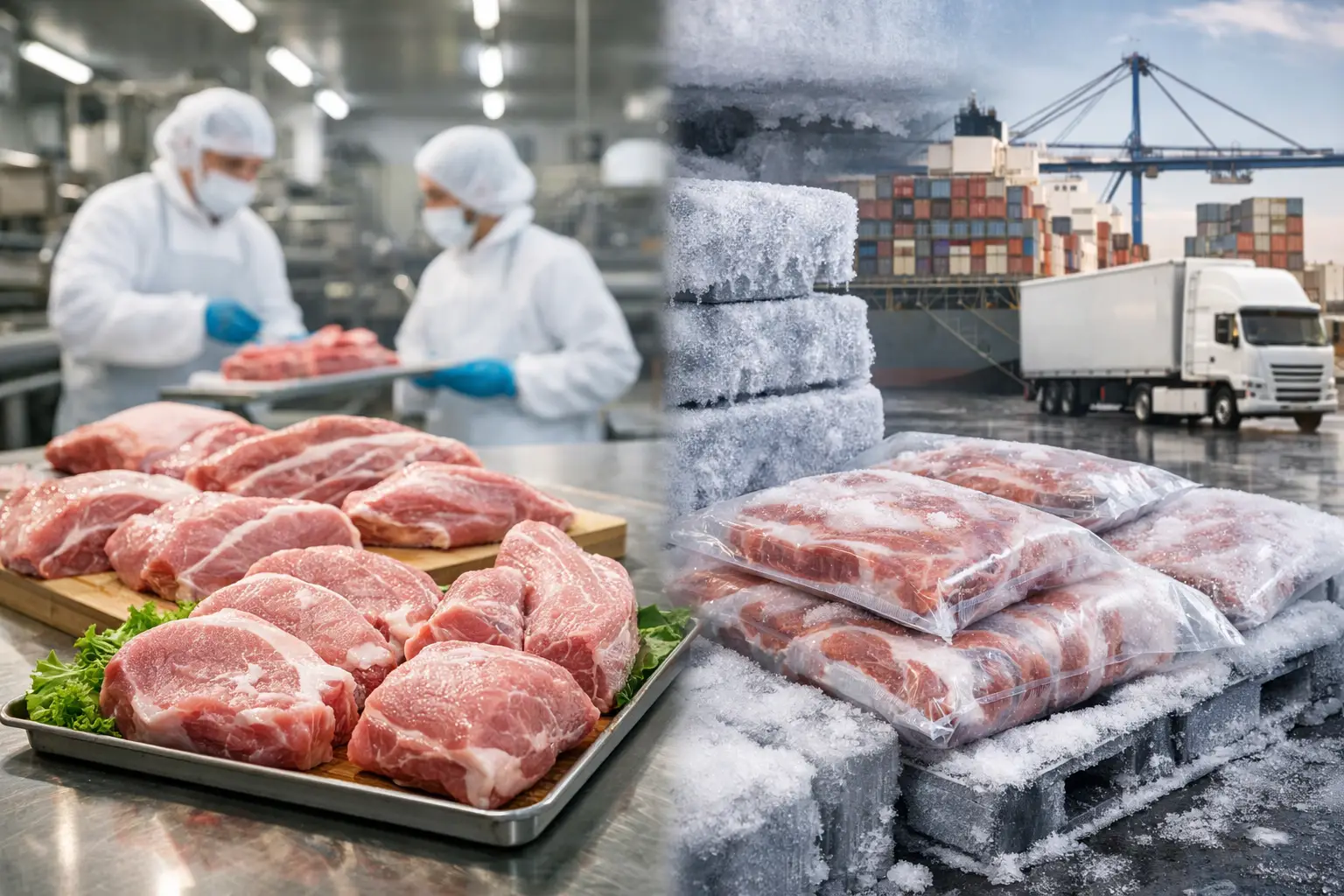
For an importer, the choice between chilled versus frozen pork is not simply a matter of storage temperature. It affects transit planning, inventory strategy, packaging specifications, customer service, product yield, and the markets that can be supplied reliably. The right format depends on the destination, the intended application, expected order frequency, and the buyer’s ability to maintain a controlled cold chain after delivery.
Spanish pork processors serving international markets commonly supply both formats because each answers a different commercial need. Chilled pork supports short, carefully managed supply chains and customers seeking fresh product for cutting, retail packing, or further processing. Frozen pork provides greater planning flexibility, broader geographic reach, and security against demand fluctuations. A procurement decision should assess the complete supply chain rather than treating one format as inherently better.
Reviewed by Litera Meat. Last updated: 6 October 2026. Based on Litera Meat’s published plant information and the public sources listed at the end. Import rules change, so confirm the current requirements of your destination market before shipping.
Key takeaways
- Chilled pork is a short-window, speed-driven product; frozen pork gives more planning and logistics flexibility.
- Under EU rules, fresh meat must reach a core temperature of 7 °C or less (3 °C for offal) and stay there in storage and transport.
- Frozen contracts commonly specify −18 °C or colder, with the exact figure agreed in the specification.
- Either format depends on process discipline and an unbroken cold chain.
Chilled versus frozen pork: the commercial difference
Chilled pork is held at refrigeration temperatures and distributed within a defined use-by period. It is usually selected when the customer needs product that remains suitable for immediate cutting, case-ready packing, foodservice preparation, or processing without a thawing stage. In regional and well-coordinated export flows, chilled supply can help buyers reduce handling time and respond quickly to regular demand.
Frozen pork is brought to and kept at freezing temperatures to preserve it for substantially longer periods. It is particularly useful for long-distance exports, variable sales cycles, seasonal programs, and customers that need to build inventory before allocating product to several locations. Freezing can apply to a broad range of cuts, trim, and edible offal, enabling buyers to plan purchases around production schedules and market availability.
Neither format removes the need for disciplined temperature control. Chilled product must remain within its specified refrigeration range from packing through receipt and onward distribution. Frozen product must remain fully frozen and protected from temperature fluctuations that may affect appearance, purge, texture, packaging integrity, or shelf-life management. In both cases, documented control and traceability are central to buyer confidence.
When chilled pork is the right choice
Chilled pork is often appropriate where transit times are predictable and the buyer has a fast route from receiving dock to production line, retail distribution center, or local market. It can be a practical option for customers in nearby European markets and for supply programs supported by frequent departures and established temperature-controlled logistics.
For processors, chilled raw material may simplify production scheduling because it can move directly into boning, slicing, marinating, grinding, or packing operations. Retail and foodservice customers may also value the ability to receive product ready for short-term sale or preparation. However, these benefits only hold when demand forecasts, warehouse turnover, and delivery timing are closely aligned.
The principal limitation is time. Chilled programs require accurate coordination among the processor, carrier, importer, warehouse, and final customer. Delays at ports, border controls, or receiving locations can reduce the useful commercial window. Buyers should therefore review not only the supplier’s packing date and stated shelf life, but also planned transit duration, customs procedures, unloading capacity, and contingency arrangements.
Chilled product also requires clear agreement on packaging. Vacuum-packed cuts can support protection and controlled distribution, but pack format, carton strength, pallet pattern, labeling language, and traceability information must match the destination market and the buyer’s operations. A package designed for direct distribution may not be the most efficient format for a plant that will open, portion, and repack the product immediately.
When frozen pork offers better procurement control
Frozen pork is generally the more resilient format for distant destinations, sea freight, and customers serving multiple downstream channels. Its longer storage potential allows buyers to purchase commercial volumes when supply conditions are favorable, then release stock according to customer orders. This can be valuable for importers supplying wholesalers, food manufacturers, and distributors across large territories.
For manufacturers, frozen pork can support stable raw-material availability when production volumes change from month to month. Standardized frozen cuts and offal can be allocated to defined recipes, trimming specifications, or product lines with less exposure to short-term delivery disruption. This does not mean frozen supply is operationally simple. Storage capacity, stock rotation, lot separation, and thawing procedures must be managed carefully to protect quality and prevent avoidable loss.
Frozen pork may require a thawing stage before further processing or sale, which should be included in production planning. Controlled thawing affects labor schedules, refrigeration capacity, drip management, and the timing of subsequent processing. The operational cost should be compared with the benefits of inventory flexibility, lower risk from transit delays, and the ability to purchase less frequently in full-container or larger-volume programs.
Buyers should also distinguish between product frozen soon after processing and product that has already spent time in a chilled supply chain before freezing. The supplier should provide transparent specifications covering product status, packing date, freezing process, storage requirements, and applicable shelf-life information. These details help procurement and quality teams compare offers on a like-for-like basis.
Quality depends on process discipline, not format alone
A common sourcing mistake is to assume that chilled pork always delivers higher quality or that frozen pork is only suitable for lower-value applications. Product quality is determined by the condition of the raw material, hygienic handling, processing controls, packaging, freezing performance where applicable, and preservation of the cold chain. The intended use also matters. A pork shoulder for industrial cooked products has different functional requirements from a loin intended for retail portions.
For chilled pork, temperature consistency and rapid distribution are especially significant. For frozen pork, the speed and consistency of freezing, prevention of dehydration, and stable frozen storage are key concerns. In either case, a buyer should assess supplier controls rather than relying on the format label alone.
A capable export supplier should be able to provide specifications that define the cut, anatomical description, trim level, weight range, packaging configuration, labeling, storage instructions, and lot identification. For regulated markets, documentation and plant approvals must also align with destination requirements. This level of clarity reduces disputes over yield, presentation, and customer expectations after arrival.
Questions procurement teams should ask before choosing
The decision is strongest when commercial, technical, and logistics teams evaluate it together. A chilled program may look attractive based on unit price but become less efficient if it generates urgent deliveries, short-dated inventory, or product write-offs. Frozen product may have additional freezing and storage costs but create value through better purchase planning and fewer supply interruptions.
Before confirming a program, buyers should establish four points: the realistic door-to-door transit time, the product’s intended use after delivery, the destination’s storage and inspection capability, and the acceptable inventory period. They should then confirm the supplier’s packing format, temperature-control records, traceability system, export documentation process, and ability to maintain consistent specifications across recurring orders.
It is also useful to review product yield in the buyer’s own operation. Trim, bone content, fat cover, cut weight, purge after thawing, and packaging efficiency can influence the true delivered cost more than a small difference in quoted price. Trial shipments or validated production samples can provide more reliable information than assumptions based on a product description alone.
Building the right supply model with a Spanish processor
For international buyers, the most effective model is often a combination of chilled and frozen supply rather than an exclusive choice. Chilled pork can serve regular, time-sensitive demand where transport is dependable. Frozen pork can provide strategic inventory for remote markets, promotional volumes, seasonal demand, and continuity planning. The mix should reflect the buyer’s sales pattern and cold-storage resources.
Litera Meat operates an integrated pork-processing platform in Binéfar, Spain, covering slaughter, cutting, cold-chain handling, packaging, quality control, and commercial distribution. With 22 cutting lines and in-house laboratory capability, its operational structure is designed to support controlled production and traceability across commercial pork programs. For buyers, this integration can simplify specification management from processing through export preparation.
The practical question is not whether chilled or frozen pork is superior. It is which format protects product condition, supports the customer’s production schedule, and delivers the most reliable total cost for the destination. A well-defined specification and a cold-chain plan agreed before shipment will usually create more value than choosing a format on price alone.
Chilled and frozen pork compared
| Point | Chilled | Frozen |
|---|---|---|
| Temperature | Core 7 °C or less (offal 3 °C or less) under EU rules, maintained in storage and transport | Set in the contract; commonly −18 °C or colder |
| Shelf life | Short, so the minimum remaining life on arrival must be agreed | Longer, which allows more flexible planning |
| Typical logistics | Fast, tightly scheduled transport | Suits longer routes and stock building |
| Planning | Frequent, smaller shipments | Larger consignments and forward stock |
| Main risk | A delay or temperature break | Thaw and refreeze, or an interrupted cold chain |
| Litera Meat range | Ask us about availability | The product range on this site lists frozen cuts and offals |
Frequently asked questions
Which format is better for long-distance export?
Frozen usually gives more flexibility because the usable window is longer, but the right choice depends on the market, the product and your inventory model.
Does freezing lower pork quality?
Quality depends mainly on how quickly the product is frozen, how well the packaging protects it and whether the cold chain stays unbroken. Poor handling does more damage than freezing itself.
What temperature limits apply to chilled pork in the EU?
Regulation (EC) No 853/2004 sets a core temperature of 7 °C or less for meat other than offal and 3 °C or less for offal, and Regulation (EU) 2017/1981 covers temperature conditions during transport.
Sources and further reading
- Regulation (EC) No 853/2004: specific hygiene rules for food of animal origin (EUR-Lex)
- Commission Regulation (EU) 2017/1981: temperature conditions during transport of meat (EUR-Lex)
See the products we supply, or get in touch with your requirements.
7 thoughts on “Chilled Versus Frozen Pork for Global Buyers”