

Latest News
How to Source Spanish Pork for Global Supply

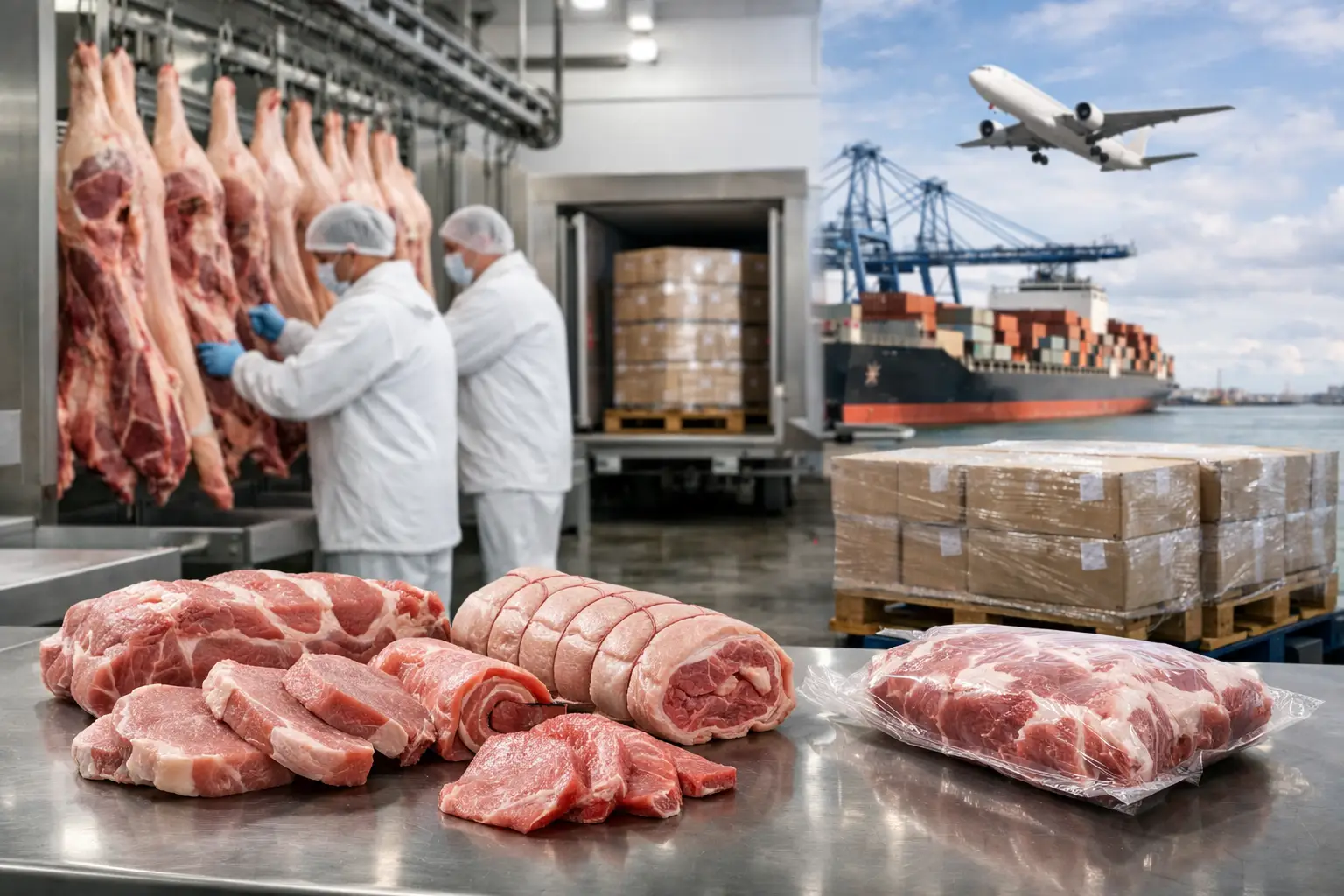
A pork specification can look correct on paper and still fail at the destination market. The difference is often found in details that sit outside the cut itself: plant approval status, chilling capacity, labeling control, microbiological monitoring, documentation, and the supplier’s ability to maintain the agreed program at volume. For buyers evaluating how to source Spanish pork, the process should begin with supply-chain capability, not only price per kilogram.
Spain is a significant European pork-producing country with an export-oriented processing sector. This creates choice for importers, distributors, manufacturers, and retail buying teams, but it also makes supplier evaluation essential. A reliable sourcing decision connects product requirements with a processor that can control production, cold-chain handling, and export execution from origin to loading.
How to source Spanish pork: start with a clear specification
Before requesting quotations, define the commercial and technical specification in sufficient detail for a supplier to assess feasibility. “Pork shoulder” or “pork belly” is rarely enough for an international program. The requested cut may vary by trimming standard, bone-in or boneless presentation, weight range, fat coverage, rind requirement, and packaging format.
A complete specification should state the product name and cut description, fresh or frozen condition, target weight and tolerance, trim standard, packaging type, carton configuration, labeling language, shelf-life requirement, and required destination approvals. For manufacturing customers, it should also identify the intended use, such as further processing, slicing, cooking, or sausage production. This helps the processor recommend a cut and packing format that fits the operation rather than simply matching a generic description.
Offal requires the same level of precision. Liver, heart, kidney, tongue, head meat, feet, ears, stomach, and other variety meats can have highly specific market requirements. Buyers should define cleaning, separation, grading, freezing method, pack weight, and acceptable presentation before production is scheduled.
Specifications also need commercial flexibility. A narrow weight range or highly customized trim can improve consistency for the end user, but it may reduce yield and affect availability or cost. The right balance depends on whether the buyer is serving retail, foodservice, further processing, or wholesale distribution.
Evaluate the processor, not only the trading offer
A trading company may provide useful market access and logistics support. However, buyers should establish which party owns and controls the production process. When purchasing direct from a processor, ask how slaughter, cutting, packaging, laboratory control, storage, and dispatch are organized. The answers reveal whether product consistency is managed at the source or assembled from multiple facilities.
Industrial scale matters when demand is regular, multi-container, or spread across several product categories. It supports production planning, standardized cutting, supply continuity, and the ability to respond when specifications change. Scale alone is not a guarantee of suitability, but it is relevant when a buyer needs repeatable volumes over time rather than opportunistic spot purchases.
Litera Meat operates an integrated fresh-pork processing platform in Binéfar, Spain, covering slaughter, cutting, cold-chain handling, packaging, quality control, and commercial distribution. With 22 cutting lines and capacity to process 160,000 pigs weekly, its operating model illustrates what buyers should look for in a large-scale Spanish supplier: control across the production lifecycle and the capacity to organize commercial supply programs.
During supplier qualification, request practical information about facility flow and product segregation. A buyer should understand how fresh and frozen products are managed, how lots are identified, where temperatures are monitored, and how nonconforming product is isolated. These operational controls have a direct effect on the reliability of every shipment.
Confirm food safety, traceability, and laboratory controls
Food safety documentation should be reviewed as a working system, not treated as a box-checking exercise. Ask the supplier to explain its hazard-control approach, sanitation verification, microbiological testing program, foreign-material controls, allergen management where relevant, and corrective-action process. The documentation required will vary by market and customer category, but the underlying question is consistent: can the supplier demonstrate control from animal intake through finished-product dispatch?
Traceability is equally important. A processor should be able to connect a finished carton or pallet to a defined production lot and retrieve the related production records efficiently. For international buyers, this supports inventory management, complaint handling, recall preparedness, and confidence in the documentation accompanying the shipment.
In-house scientific laboratory capability can add meaningful value because it supports routine verification close to the production process. Buyers should still confirm the scope of testing, reporting format, retention of records, and how results are acted upon. A laboratory is useful only when it is integrated into decision-making on the plant floor.
Animal welfare and environmental practices also increasingly form part of supplier approval. These subjects should be assessed through policies, procedures, training, facility design, and measurable operating practices rather than broad statements. They can influence customer acceptance, regulatory expectations, and long-term business continuity.
Match fresh or frozen supply to your operating model
Fresh and frozen pork serve different procurement objectives. Fresh chilled product can suit nearby regional markets and customers seeking a specific shelf-life profile. It demands tightly coordinated production, loading, transport, receiving, and inventory rotation. A delay at any point can reduce the usable selling window.
Frozen pork offers greater flexibility for long-distance distribution, variable sales cycles, and inventory planning. It can allow buyers to consolidate shipments, build stock ahead of seasonal demand, and serve markets where transit times are longer. The trade-off is that freezing method, storage conditions, thawing performance, and carton integrity become central to product quality at use.
Do not assume frozen is automatically simpler or fresh is automatically better. The correct choice depends on transit time, port reliability, warehouse capacity, customer handling practices, and the intended application. A food manufacturer may prioritize stable frozen inputs, while a retailer with a proven refrigerated distribution network may require chilled supply.
Verify export readiness for the destination market
Spanish origin does not by itself confirm eligibility for every market. Import rules may depend on the approved establishment, product category, health certificate, labeling details, veterinary conditions, residue requirements, and market-specific protocols. These conditions can change, so they should be verified before commercial commitments are made.
Ask a prospective supplier whether it is authorized for the destination and whether it has current experience preparing the required export documentation. This is particularly relevant for demanding markets in Asia, where approval lists and certificate requirements can be highly specific. Experience shipping to China, Japan, South Korea, the Philippines, Vietnam, Singapore, and Hong Kong can be useful, but buyers should confirm suitability for their exact product and import program rather than rely on a general export claim.
Documentation should be aligned before production begins. Confirm the product description, establishment information, lot references, net weights, carton marks, certificate data, and consignee details. Small inconsistencies can lead to clearance delays, storage costs, or rejected paperwork at destination.
Build the cold chain into the purchase decision
Cold-chain performance is part of the product, especially for international trade. Discuss loading temperature, pre-shipment storage, container setting, data recording, pallet configuration, and loading plan. For frozen cargo, confirm the expected storage temperature and how product temperature is protected during transfer from cold store to container. For chilled cargo, clarify the temperature range and remaining shelf life required at arrival.
Packaging must be fit for the route as well as the customer. Vacuum packs, liners, cartons, pallet wrap, and labels need to withstand handling across warehouses, ports, and distribution centers. Buyers should request packing details and, where appropriate, review samples or trial shipments before expanding into regular volumes.
Incoterms, insurance responsibilities, payment terms, and claim procedures should be agreed with the same care as the cut specification. A well-priced shipment can become expensive if responsibility for a temperature deviation, damaged carton, or document error is unclear.
Qualify with a trial, then measure performance
A trial order is most useful when it tests the full process. Instead of treating it as a small price check, use it to assess specification accuracy, packaging, documentation, loading communication, transit performance, and destination receiving results. Record deviations objectively and agree on corrective actions before moving to larger volumes.
For recurring business, establish a short performance review covering order accuracy, production lead time, shipment punctuality, certificate accuracy, temperature records, claims, and response times. This creates a factual basis for supplier development and makes forecasting easier for both sides.
The strongest Spanish pork sourcing relationships are built on precise specifications, transparent controls, and realistic planning. When a supplier can explain how it manages each stage from production through export dispatch, buyers are in a better position to create a supply program that remains dependable as volumes, markets, and customer requirements evolve.