
Latest News
EU Meat Certification for International Pork Buyers

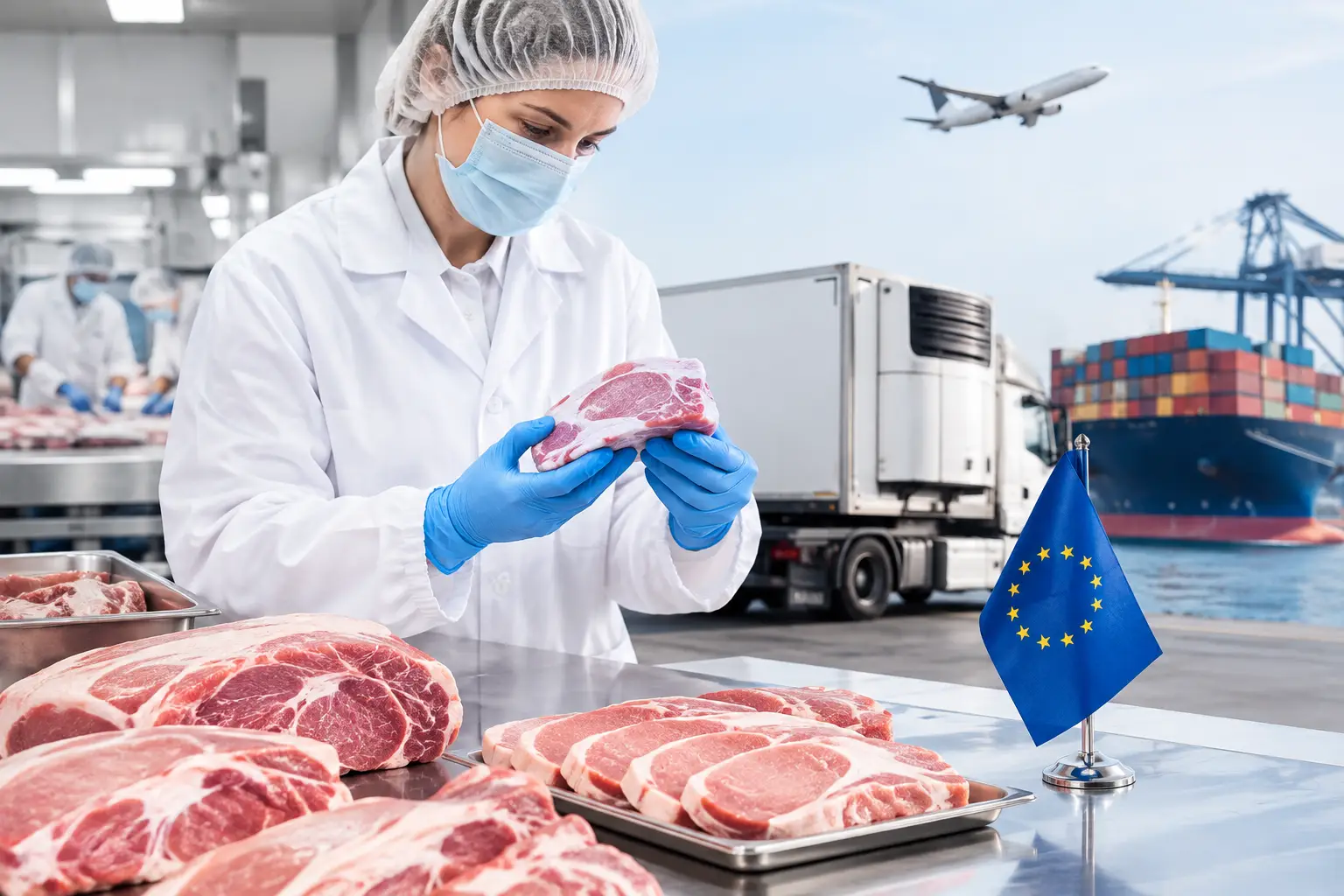
A shipment of pork can meet the right specification, price, and delivery schedule yet still be unsuitable for import if its regulatory documentation is incomplete. For professional buyers, EU meat certification is not one document or one private standard. It is a practical framework of establishment approval, official controls, health marking, traceability, and export certificates that supports safe trade in pork and pork products.
Understanding that distinction helps procurement teams compare suppliers properly. It also avoids a common sourcing mistake: treating a general quality certificate as proof that a product is approved for a particular destination market.
What EU meat certification means in practice
In commercial discussions, “EU meat certification” is often used as a broad term. In practice, the requirements depend on the product, the country of destination, the intended use, and the importing authority’s rules. The central requirement is that meat placed on the EU market must come from an approved establishment operating under applicable EU food hygiene, animal health, and official-control rules.
For pork processors, this begins at the approved slaughterhouse and continues through cutting, packaging, storage, and dispatch. Establishments are subject to oversight by competent authorities. Their operations must apply hygiene procedures based on Hazard Analysis and Critical Control Point principles, commonly known as HACCP, alongside prerequisite programs for sanitation, pest control, maintenance, staff hygiene, water quality, temperature management, and allergen control where relevant.
A buyer should therefore view certification as a chain of evidence rather than a single logo. The relevant evidence may include establishment approval details, product identification, lot records, temperature records, official health documentation, and destination-specific certificates.
Establishment approval and the health mark
The health mark is one of the most useful identifiers for buyers sourcing EU pork. It confirms that the meat was produced in an establishment approved by the competent authority and subject to official inspection. The mark identifies the country and approval number of the facility, together with the EU designation.
This is different from a brand label, commercial quality claim, or voluntary audit certificate. The health mark is linked directly to the legal status of the production site. Buyers should verify that the approval number corresponds to the establishment named in the commercial documents and, where required, in the veterinary certificate.
The scope of approval also matters. A facility approved for slaughter and cutting may have different activities from one approved only for cold storage or processing. For procurement teams, checking the site’s role in the supply chain provides greater clarity on where product handling, packing, and control activities take place.
Traceability is the operational core
Traceability is essential to EU meat certification because it connects the product in a container or pallet to the records behind it. An effective traceability system should allow the supplier to identify the origin of the animals or incoming raw material, the production date, the processing line or batch, the packaging date, storage conditions, and the customer shipment.
For fresh pork, time and temperature control are particularly significant. Buyers should expect product labels and documents to clearly state the lot or batch reference, production or packing date, use-by date where applicable, storage conditions, net weight, product description, and establishment identification. Frozen pork requires the same discipline, with additional attention to freezing date, cold-chain records, and shelf-life management.
Traceability is not only relevant when a problem occurs. It supports routine purchasing decisions. It enables a buyer to reconcile the purchase order, carton label, packing list, invoice, certificate, and shipping documents before goods arrive at the port or distribution center.
Questions that reveal traceability capability
A capable supplier should be able to explain how it manages lot separation and how quickly it can retrieve information for a specific shipment. Buyers should ask whether traceability records connect the slaughter date, cutting or packing date, product code, carton label, pallet configuration, and export documentation.
It is also reasonable to ask how the supplier handles product holds, nonconforming material, corrective actions, and withdrawal procedures. The answer should describe a controlled process, not simply confirm that a procedure exists.
Official controls and laboratory verification
EU requirements place responsibility for food safety on the food business operator while competent authorities conduct official controls. In a pork plant, this involves a combination of veterinary inspection, hygiene verification, microbiological monitoring, residue-control programs, and review of operational conditions.
The exact testing plan varies by operation and product. However, buyers should understand that laboratory analysis is one component of a wider food-safety system. A certificate of analysis can be valuable for an agreed specification or customer requirement, but it does not replace establishment approval, official inspection, or a complete traceability program.
For large-scale pork sourcing, in-house laboratory capability can improve the speed of routine verification and support informed release decisions. It should work alongside documented sampling plans, defined acceptance criteria, calibrated equipment, trained personnel, and corrective-action procedures. Third-party laboratory testing may also be needed when customer specifications or importing-country rules require it.
Private certifications and legal market access are not the same
Many processors hold voluntary certifications that may be relevant to supplier approval programs. These can address food-safety management, quality systems, animal welfare, environmental practices, or customer-specific requirements. They may provide useful assurance, particularly for retail, foodservice, or food-manufacturing supply chains.
However, private certification does not automatically grant market access. An importer must still confirm that the originating establishment, product category, and supporting documents meet the requirements of the destination country. This distinction is especially important outside the European Union, where bilateral veterinary agreements and country-specific import protocols can apply.
A supplier may be fully compliant for EU trade but not listed or approved for every export market. Conversely, a plant may be authorized for certain destinations and product categories but not others. Procurement teams should confirm eligibility before finalizing specifications, production schedules, or shipping arrangements.
Export certification for markets outside the EU
When EU pork is exported to non-EU markets, official veterinary certification is commonly required. The certificate format, declarations, and inspection process depend on the importing country. Requirements may cover animal health status, slaughter and processing conditions, product origin, storage temperature, manufacturing dates, labeling, sealing, or transport controls.
For markets with demanding import procedures, buyers should verify export approval early. This is particularly relevant for shipments to Asian markets, where establishment listings, document wording, labeling rules, and pre-shipment procedures may be detailed. A document that is acceptable for one destination may not be accepted for another.
The product description must also match throughout the document set. Differences between the commercial invoice, packing list, carton labels, bill of lading, and health certificate can delay customs clearance. The same applies to inconsistent net weights, dates, establishment numbers, or container seal details.
A practical review before placing an order
Before approving a new EU pork supplier, a buyer should request the establishment approval number and confirm the facility’s scope of activity. The product specification should define the cut, trim, fat level, packaging format, fresh or frozen status, weight range, shelf-life expectations, and labeling language.
The buyer should then confirm the traceability format to be used on cartons and pallets, as well as the documents supplied with each shipment. For export business, the parties should agree in writing on the destination-specific health certificate, required declarations, inspection timing, and responsibility for document review before loading.
Commercial scale adds another consideration. A processor may be technically compliant but unable to maintain consistent specifications across regular volumes. Buyers sourcing substantial quantities should assess cutting capacity, cold storage, packing capability, quality-control resources, and contingency planning. Industrial facilities with integrated slaughter, cutting, cold-chain handling, packaging, and laboratory functions can provide greater control over the production chain when these activities are managed within a coordinated system.
Certification should support, not replace, supplier evaluation
Documents are necessary, but they are not the whole assessment. The strongest procurement decisions combine regulatory verification with a practical review of operational performance. This includes product consistency, communication speed, claim handling, on-time delivery, temperature-control discipline, and the supplier’s ability to adapt documentation to the destination market.
Spanish pork exporters serving international buyers must manage this balance carefully. They need to meet EU requirements while preparing products and records for markets with different veterinary, commercial, and logistical expectations. For buyers, the value lies in working with a supplier that treats compliance as part of everyday production control rather than as paperwork prepared at the end of the process.
The most useful question is not simply, “Do you have EU meat certification?” It is, “Can you demonstrate legal compliance, full traceability, approved production, and the exact export documentation required for this product and destination?” A supplier that can answer clearly gives purchasing teams a stronger basis for reliable long-term sourcing.