
Latest News
Top Pork Quality Indicators for B2B Buyers

A pork specification can look complete on paper while leaving major commercial questions unanswered. For importers, processors, and distributors, the top pork quality indicators are not limited to visual appearance or cut price. They show whether a supplier can deliver safe, consistent product that performs predictably through transport, storage, further processing, and sale.
For international procurement, quality should be assessed as a controlled system. The condition of the meat matters, but so do slaughter practices, laboratory verification, temperature management, documentation, packaging integrity, and the supplier’s ability to repeat the same standard at commercial volume.
Top Pork Quality Indicators: Start With Food Safety
Food safety is the first condition of acceptability. A buyer should be able to understand how hazards are identified, controlled, monitored, and documented from animal reception through dispatch. This includes hygiene controls in slaughter and cutting areas, sanitation procedures, segregation of edible products and by-products, and clear protocols for non-conforming product.
Microbiological monitoring is a central part of this assessment. Results should be interpreted in the context of the product, destination market requirements, and intended use. Fresh cuts for retail, boneless meat for further processing, and edible offal may have different risk profiles and handling requirements. A reliable supplier uses laboratory testing and environmental monitoring as verification tools, not simply as documents prepared for an audit.
Buyers should also confirm whether the supplier can meet the importing country’s veterinary, health certificate, labeling, and market-access requirements. A product that meets a general specification may still be unsuitable if its establishment approval, documentation, or residue-control records do not meet the requirements of the destination.
Meat Condition and Physical Quality
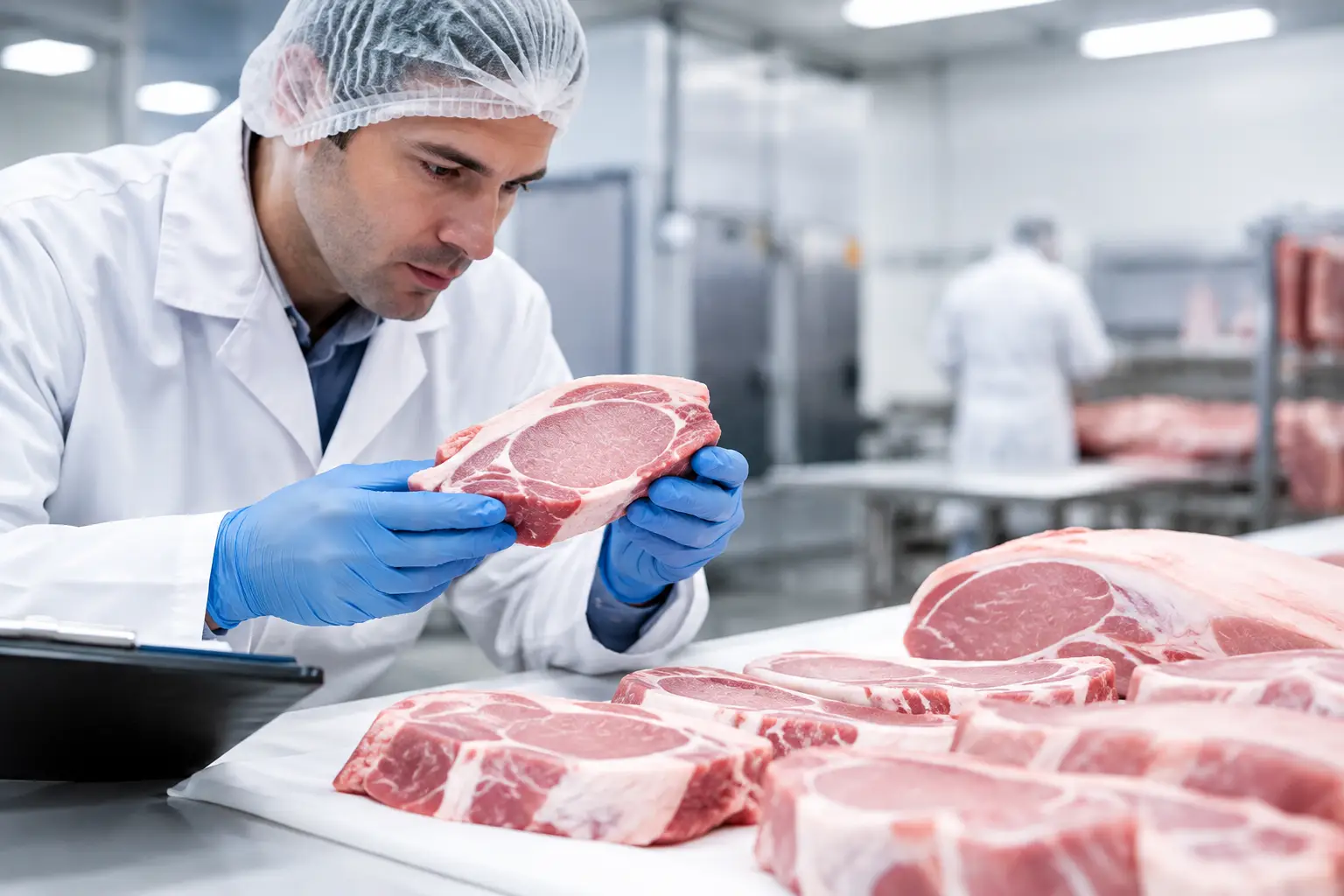
Physical quality determines how pork will look, handle, and perform after delivery. Color, surface condition, odor, trimming quality, fat cover, bone condition, and the absence of contamination should be assessed against an agreed specification. These controls are particularly important when product will be displayed in retail packs or used in applications where appearance affects acceptance.
Color should be evaluated carefully. Pork that is excessively pale, soft, and exudative can create drip loss and weaker presentation. Meat that is unusually dark, firm, and dry may also indicate processing or handling issues. There is no single color target for every cut, since muscle type, packaging format, and intended use all matter. The key is consistency within the agreed product standard.
Water-holding capacity is another practical measure. Excess purge in vacuum packs reduces visual appeal, can affect net weight perception, and may create difficulties in slicing or further processing. For manufacturers, it can also influence cooking yield and formulation performance. Buyers sourcing loin, ham, shoulder, or trimming for industrial use should discuss expected purge and yield behavior rather than relying only on a general freshness statement.
Texture and pH are closely connected to these outcomes. Controlled handling before slaughter, appropriate chilling, and disciplined processing conditions help support normal pH development and stable meat characteristics. Procurement teams do not need to manage these parameters directly, but they should expect their supplier to understand and control the conditions that affect them.
Cut Accuracy, Yield, and Product Consistency
A commercial pork order is successful when the delivered product matches the agreed specification across each shipment. This means correct cut definition, weight range, trim level, fat percentage where applicable, bone-in or boneless status, and packaging count. Small variations can have significant financial consequences when they are repeated across container-scale volumes.
For example, a food manufacturer buying shoulder for cooked products may prioritize lean-to-fat ratio, particle size after grinding, and functional yield. A retail buyer may place greater emphasis on portion weight, visual uniformity, and pack presentation. An importer buying frozen offal may focus on correct identification, cleaning standard, block weight, and protection against dehydration. Quality is therefore application-specific.
Specifications should define tolerances, not just targets. A stated weight range is useful only when the buyer and supplier agree how samples are taken, how non-conformance is measured, and what happens if tolerance limits are exceeded. The same applies to foreign material, bone fragments, residual hair, cartilage, and trim defects.
At industrial scale, consistency depends on trained teams, calibrated equipment, standardized cutting methods, and inspection at critical points. Automated systems can improve repeatability, but they do not replace experienced quality personnel. The strongest operations combine technology with active verification on the production floor.
Temperature Control Is a Quality Indicator, Not Just a Logistics Detail
Cold-chain performance protects safety, shelf life, color, texture, and commercial value. Meat may leave a plant in good condition but arrive with reduced shelf life if temperature control is inconsistent during loading, sea freight, road transport, or receiving.
Buyers should establish the required product temperature at dispatch and define how it will be monitored. For chilled pork, loading discipline, pre-cooled vehicles or containers, transit duration, and packaging format all affect the result. For frozen pork, stable low temperatures are essential to limit surface dehydration, freezer burn, and changes in texture caused by temperature fluctuation.
Temperature records should be available when required by the specification or contract. However, a report alone is not enough. Procurement teams should consider the supplier’s loading procedures, cold-storage capacity, contingency planning, and experience with the transit lanes involved. A long-distance export program requires different controls from local delivery.
Packaging is part of cold-chain protection. Vacuum packaging, modified-atmosphere formats, liners, cartons, and pallet configuration should suit the product and route. Packaging must protect the meat while allowing efficient handling at destination. A format designed for a short domestic supply chain may not be suitable for extended international distribution.
Traceability and Documentation Build Buyer Confidence
Traceability connects the delivered carton to the production process behind it. A practical system should allow the supplier to identify the lot, production date, product description, plant records, and dispatch information quickly. When an issue is identified, traceability supports focused investigation and corrective action rather than broad, disruptive uncertainty.
For B2B buyers, documentation should be accurate, consistent, and aligned across labels, packing lists, invoices, veterinary certificates, and shipping documents. Discrepancies in carton marks, net weights, dates, or product names can delay customs clearance even when the meat itself meets quality expectations.
Ask how lot coding works in practice. Can the supplier trace a production lot backward to relevant operational records and forward to the customers or shipments affected? Can product be segregated effectively if a question arises? The speed and clarity of these answers often reveal more than a generic statement about traceability.
Assess the Supplier’s Process, Not Only the Product Sample
A pre-shipment sample is useful, but it cannot demonstrate long-term supply reliability on its own. Buyers should assess whether the supplier has the capacity, controls, and technical support to maintain specifications across changing production conditions and recurring orders.
Relevant questions include how quality complaints are investigated, how corrective actions are documented, how laboratory capability supports release decisions, and how specifications are reviewed when a buyer’s market requirements change. It is also reasonable to ask how the producer manages animal welfare, employee training, equipment maintenance, water use, and waste streams, because these practices influence operational discipline and supply continuity.
Spanish producers serving export markets must combine efficient production with detailed compliance management. Litera Meat operates an integrated platform in Binéfar, Spain, covering slaughter, cutting, cold-chain handling, packaging, quality control, and commercial distribution. For buyers, this type of integrated structure can simplify communication and strengthen control across the stages that affect product condition and shipment readiness.
A Practical Quality Review Before Contracting
Before approving a pork supplier, procurement teams should align the product specification, inspection method, documentation requirements, packaging format, shipping temperature, and complaint process. These points are interdependent. Tight trim tolerances may affect price and availability; a longer shelf-life requirement may require a different packaging and logistics plan; and a destination’s import rules may determine which labels and certificates are necessary.
The most productive supplier discussions are specific. Instead of asking whether pork is “high quality,” ask how lot consistency is checked, what evidence is available for temperature control, how microbiological verification is managed, and which tolerances apply to the cut being purchased. Clear questions lead to clearer specifications and fewer disputes after arrival.
A dependable pork program is built before the container is loaded. When quality indicators are agreed, measured, and documented across the full process, buyers can make sourcing decisions with greater confidence and create a more stable supply relationship.