
Latest News
What Is Meat Traceability in Pork Supply?

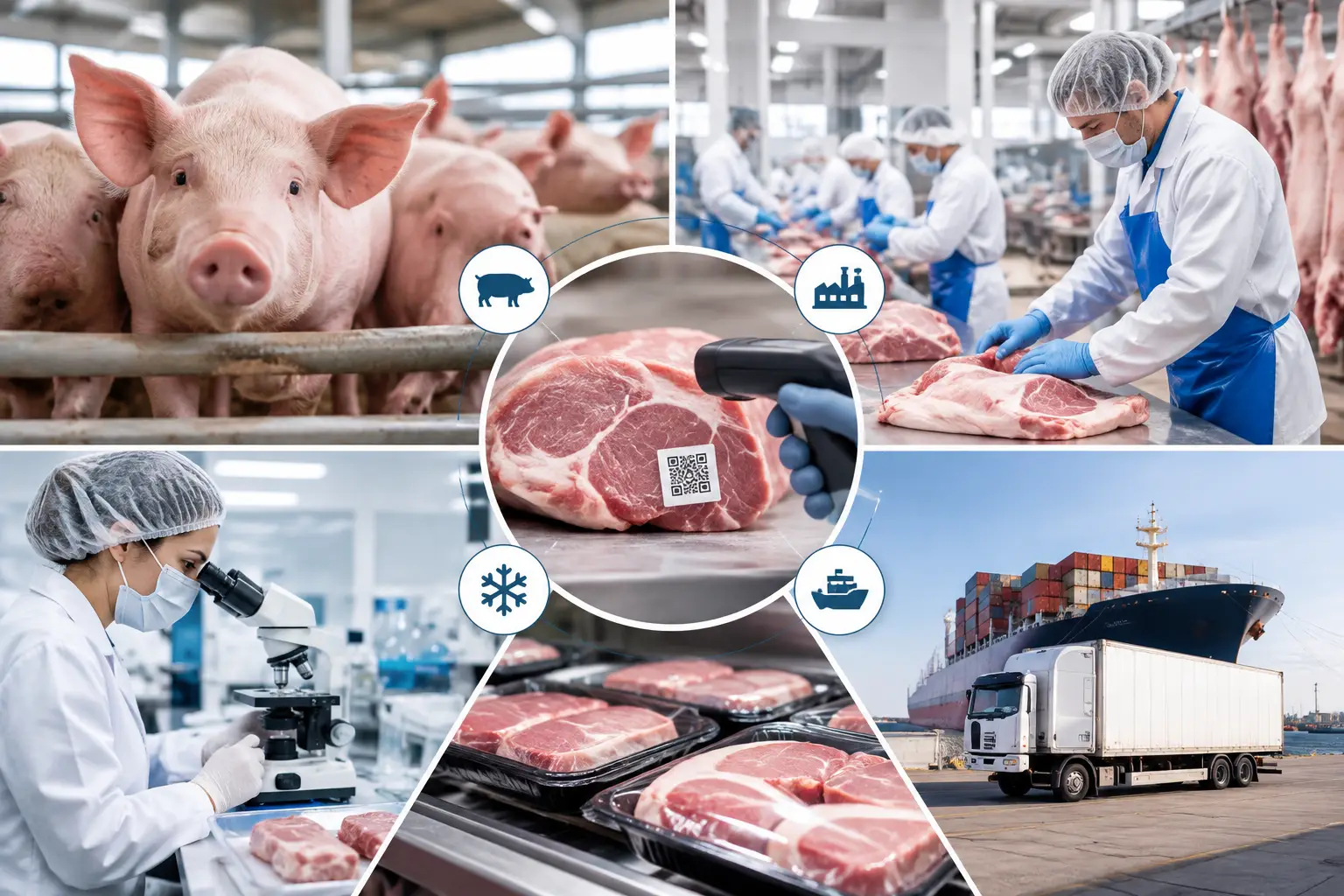
A pork container may travel thousands of miles from a Spanish processing facility to a distributor, manufacturer, or retail network. What is meat traceability in that journey? It is the documented ability to identify a product, follow its path through the supply chain, and retrieve the records that connect each lot to defined production, handling, and distribution events.
For B2B buyers, traceability is not simply a label or a barcode. It is an operating discipline that supports food safety investigations, import documentation, inventory control, specification compliance, and customer confidence. The level of detail required depends on the product, destination market, contractual requirements, and applicable regulations. However, the principle remains the same: every critical handoff should leave a reliable record.
What Is Meat Traceability?
Meat traceability is a system of records that allows a company to trace meat backward to its source and forward to its destination. In pork production, this commonly means connecting animals or animal groups, slaughter dates, production lots, cutting operations, packaging batches, storage conditions, and shipment details.
The system answers practical questions quickly. Which production lot did this carton come from? What raw material was used in a specific frozen product batch? Which customers received products from a lot under review? When was the product processed, packed, loaded, and dispatched?
Traceability is often described through two directions. Backward traceability identifies where a product came from, including relevant supplier, animal, and production information. Forward traceability identifies where that product went after it left a processing site. Effective internal traceability connects both directions within the processor’s own operations, including cutting, packing, labeling, cold storage, and order preparation.
For an importer or procurement manager, this chain of information provides a basis for evaluating how a supplier controls product identity as it moves from production to export.
How Traceability Works in a Pork Processing Plant
Traceability begins before the product reaches the cutting room. Animals or groups entering a processing operation are registered against defined intake and production information. As carcasses move through slaughter and processing, the operation maintains links between the relevant production stages and subsequent lots.
At industrial scale, the challenge is maintaining those links while processing high volumes at speed. Automated identification, production software, line controls, lot codes, and disciplined operating procedures all contribute. Technology can reduce manual recording errors, but it does not replace clear rules for lot segregation, label verification, and exception management.
From slaughter to cutting and packaging
Following slaughter, products are managed through defined production batches. During cutting, one carcass becomes a wide range of commercial items: primal cuts, retail-ready cuts, trim, fat, bones, and offal. Each item must remain associated with the appropriate lot information as it is sorted, packed, weighed, labeled, and transferred to chilled or frozen storage.
A label generally carries an identifier that links the individual case, pallet, or unit to the processor’s records. The visible information may include a lot number, production or packing date, product description, storage requirements, establishment details, and destination-specific markings. The exact label format varies by market and product category.
The lot code is particularly important. It should allow the processor to isolate a defined quantity of product without unnecessarily affecting unrelated production. A lot that is too broad can make a withdrawal larger than necessary. A lot that is too narrow may create unnecessary complexity and operational cost. Appropriate lot design depends on processing flow, product type, risk assessment, and customer requirements.
Cold chain and shipment records
Traceability does not end once a carton is packed. Products entering cold storage must be recorded by lot, location, quantity, and status. When an export order is prepared, the shipment records should connect the selected lots to the customer order, transport documents, destination, and dispatch date.
Temperature monitoring is related to traceability, although it is not the same thing. Traceability identifies the product and its movement. Cold-chain records demonstrate how the required storage conditions were controlled during relevant stages. Together, these records provide a clearer picture of product history.
For frozen pork, inventory accuracy is especially significant because products may remain in storage for extended periods before shipment. For fresh chilled pork, the need for precise planning is more immediate because shelf-life management, loading schedules, and delivery timing directly affect commercial value.
Why Meat Traceability Matters to International Buyers
International pork sourcing involves more than agreeing on a cut specification and price. Buyers must coordinate product requirements, documentation, logistics, receiving procedures, and local market obligations. Traceability gives procurement teams a structured way to verify what was supplied and manage issues if they arise.
First, it supports targeted product review. If a quality deviation, labeling question, or food safety concern is identified, the supplier should be able to determine the affected lot and provide relevant production and shipment information. This is more precise than treating an entire product range or month’s production as a single group.
Second, traceability supports specification control. A buyer sourcing boneless loins, bellies, shoulders, ribs, or pork offal may require particular cutting standards, weights, packaging formats, and freezing conditions. Lot-level records help connect the delivered product to the agreed commercial specification and production order.
Third, it improves supply-chain accountability. Distributors and food manufacturers often need to maintain their own records after receiving product. When supplier lot codes are captured accurately at goods receipt, they can be linked to warehouse movements, further processing, and customer deliveries. The traceability chain is strongest when each participant preserves those connections.
Finally, well-managed traceability supports continuity during an incident. No system can eliminate every quality or logistics issue. The practical test is whether the parties can identify affected stock, communicate clearly, hold product where necessary, and make decisions using verified records rather than assumptions.
What Buyers Should Ask a Pork Supplier
A traceability claim is more meaningful when buyers understand how it operates in practice. During supplier qualification or regular business reviews, procurement teams should ask how lots are defined across slaughter, cutting, packaging, storage, and dispatch. They should also confirm whether product labels and export documents can be reconciled with the supplier’s internal records.
It is useful to discuss the expected response process for a traceability inquiry. This includes who manages requests, what information can be provided, how quickly records can be retrieved, and how a supplier conducts internal traceability exercises. Buyers should also establish requirements for retaining labels, receiving records, and lot data within their own operations.
Questions should be adapted to the intended market. Import rules, veterinary documentation, language requirements, labeling rules, and customer audit expectations can differ between destinations. A process suitable for one market may need additional data or document controls for another.
For buyers handling multiple product categories, clarity matters more than complexity. The same approach should be understood across fresh pork, frozen cuts, and edible offal, while recognizing that each category may have different shelf-life, packaging, or logistics requirements.
Traceability Is a Shared Supply-Chain Responsibility
A processor can maintain detailed production records, but full end-to-end traceability also depends on transport providers, importers, cold stores, distributors, and manufacturers. If cases are relabeled, repacked, combined, or split, the new identification must preserve the link to the original lot. If that link is lost, the chain becomes incomplete.
This is why traceability should be considered during commercial setup, not only after an incident. Purchase specifications should define product identification, label content, document requirements, temperature expectations, and procedures for reporting discrepancies. Warehouse teams should be trained to capture lot information accurately when pallets are received and moved.
At Litera Meat, pork processing is organized across slaughter, cutting, cold-chain handling, packaging, quality control, and commercial distribution. In an integrated operation of this kind, traceability is central to maintaining control as products move through multiple production stages and toward international customers.
For buyers, the most useful next step is to make lot identification part of every supplier conversation. Ask to see how a product code connects to production and shipment records, then ensure your own receiving and inventory procedures preserve that same information. That discipline makes the supply chain easier to manage when decisions need to be made quickly.