
Latest News
Automated Pork Cutting Technology at Scale

A pork specification is only as useful as the supplier’s ability to repeat it, shift after shift and shipment after shipment. For importers, processors, distributors, and retail buyers, automated pork cutting technology is not simply a factory investment. It is a practical foundation for consistent cut presentation, yield control, traceability, food safety management, and dependable supply at commercial volumes.
The value becomes especially clear when buyers source across borders. A defined trim level, weight range, packaging format, and temperature requirement must be translated accurately from a purchase specification into daily production. Automation helps bring discipline to that process, while experienced operational teams remain essential for control, verification, and decisions that equipment cannot make alone.
What Automated Pork Cutting Technology Changes
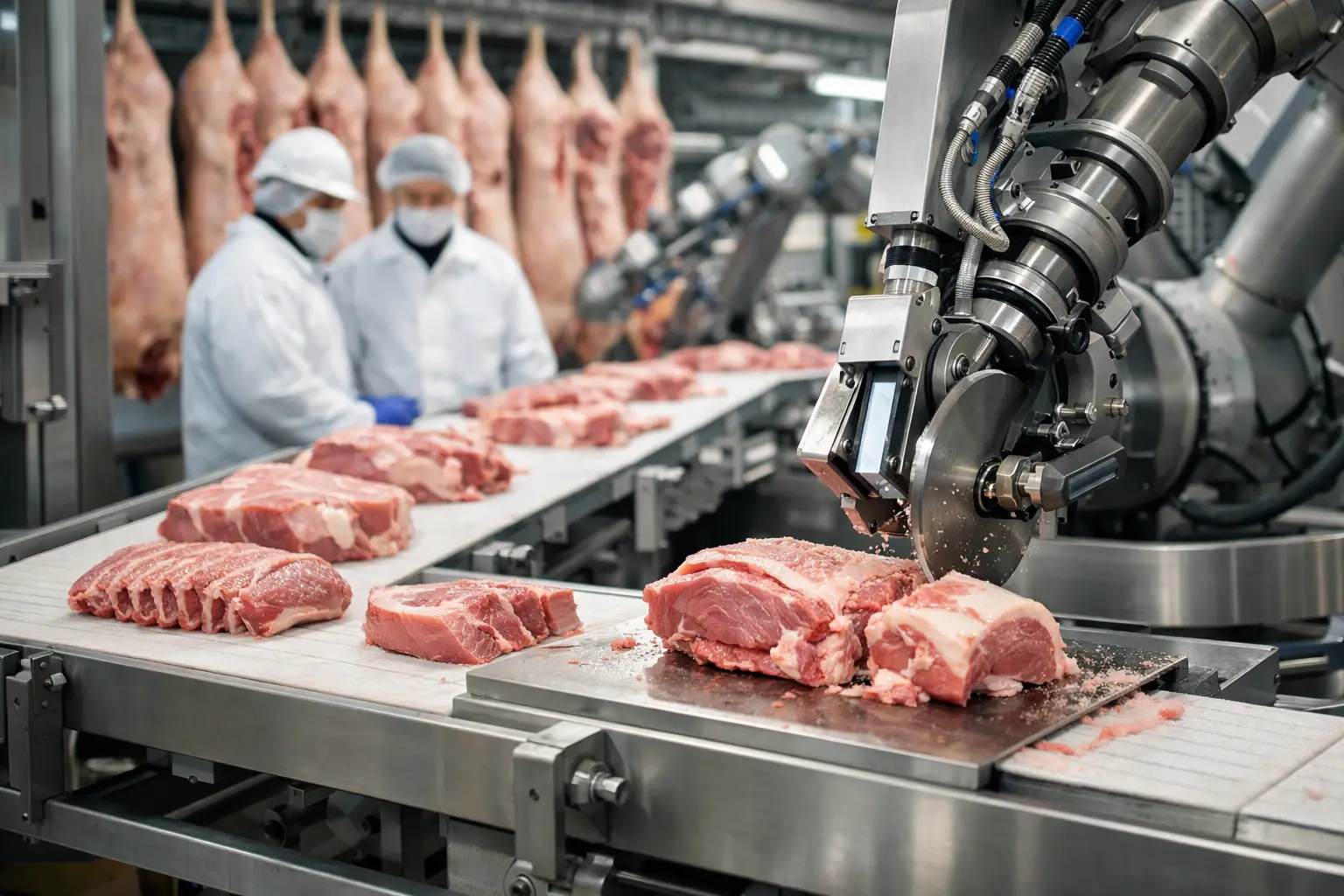
Automated cutting systems combine equipment, sensors, data capture, material handling, and process controls to support the transformation of pork carcasses into saleable cuts and offal products. Depending on the operation, this can include automated transport, weighing, grading support, portioning, cutting, sorting, packaging, labeling, and cold-chain monitoring.
The objective is not to remove expertise from pork processing. It is to make the production process more controlled and repeatable. Operators, quality teams, maintenance specialists, veterinarians, and laboratory personnel continue to play a central role. Their work is supported by systems that reduce unnecessary variation and record key production data.
For a B2B buyer, the most relevant result is greater consistency between agreed specifications and delivered product. This can support reliable downstream manufacturing, retail shelf planning, foodservice portion control, and more accurate inventory management.
More consistent cuts and specifications
Manual skill remains important in meat cutting, particularly where product selection, presentation, and quality assessment require judgment. However, manual-only processes can be more exposed to variation in cut size, trim, and workflow. Automated equipment can improve repeatability where specifications are clearly defined and production volumes justify the investment.
For example, consistent handling and weighing can help segregate products by agreed weight bands. Controlled cutting processes can support more uniform dimensions for products intended for further processing, retail packing, or foodservice distribution. The precise outcome depends on the cut, the animal characteristics, the intended market, and the customer’s specification.
Buyers should not assume that automation means every product will be identical. Fresh pork is a natural product, and variation in anatomy and raw-material characteristics remains a reality. The relevant question is whether the producer has the equipment, controls, and trained teams to manage that variation within commercially agreed tolerances.
Better yield visibility
Yield is a central commercial issue in pork cutting. Small differences in trim, recovery, handling losses, or product allocation can affect both supplier efficiency and buyer value. Automated production data can provide clearer visibility into how raw material is converted into primals, cuts, trim, fat, bones, and offal.
This information supports more disciplined production planning. It can also help suppliers match available raw material with demand for specific products, whether the requirement is for fresh pork cuts, frozen items, industrial raw material, or edible offal. For buyers, a supplier with reliable yield control is generally better positioned to maintain stable product programs and provide realistic availability information.
Automation and Food Safety Control
Food safety depends on a complete system, not on one machine. Good manufacturing practices, hygienic facility design, sanitation, microbiological control, employee training, temperature management, laboratory verification, and corrective actions all remain necessary.
Automation can strengthen that system by reducing unnecessary handling, standardizing movement through defined process stages, and recording operational conditions. Conveying and sorting systems can help separate workflows. Automated weighing and labeling can reduce transcription errors. Integrated cold-chain controls can improve visibility of temperatures during handling, storage, and dispatch.
The benefit is particularly significant for buyers operating in demanding export markets. Documentation, product identification, and lot control must support the requirements of customers, competent authorities, and destination-country regulations. A supplier should be able to explain how it maintains product identification from receipt through cutting, packaging, storage, and shipment.
Traceability must work beyond the label
A label alone is not traceability. Effective traceability connects the product to relevant information about its production lot, processing date, packaging, storage, and dispatch. In an industrial facility, digital records can make this information faster to retrieve and easier to verify.
For procurement teams, this matters before a problem occurs as much as afterward. Clear traceability supports stock rotation, shipment reconciliation, quality investigations, and efficient response if a customer requests additional documentation. It also helps suppliers manage differentiated specifications for multiple markets without losing control of product identity.
When evaluating a pork supplier, buyers should ask how lot segregation is maintained, which production records are retained, how labels are verified, and how the company can trace a finished case back through the processing flow. The answers should be practical and specific, not limited to general statements about technology.
Scale Requires More Than Fast Equipment
High-capacity pork processing creates a demanding operational environment. Automation can increase throughput, but production speed without control can create greater risk rather than better performance. Equipment must work within a coordinated system that includes maintenance, staffing, hygiene, quality checks, cold storage capacity, packaging availability, and export documentation.
This is why the strength of an automated cutting operation should be assessed across the entire production chain. A cutting line may be highly advanced, but its commercial value is limited if the product cannot be chilled, packed, stored, inspected, and shipped according to the buyer’s agreed requirements.
At Litera Meat, industrial-scale pork processing is supported by integrated operations covering slaughter, cutting, cold-chain handling, packaging, quality control, and commercial distribution. Its facilities in Binéfar, Spain include 22 cutting lines and process 160,000 pigs weekly. This scale requires coordinated process control across every stage, from raw-material handling to dispatch for domestic and international customers.
For global buyers, integrated operations can simplify supplier management. Rather than coordinating multiple parties for cutting, packing, quality documentation, and logistics preparation, buyers can work with a producer that manages these functions within a connected operational structure. The appropriate model still depends on the product, destination, volumes, and commercial terms required.
Where Automation Has Limits
Automated pork cutting technology is not a substitute for supplier capability. It does not guarantee a suitable product program, regulatory approval for a destination market, or correct execution of a customer’s specification. Those outcomes require planning, trained people, effective quality systems, and clear communication between buyer and supplier.
Some products may also require a higher level of manual handling. Specialty cuts, particular trim requirements, selected offal products, or market-specific presentations may depend on skilled cutting teams and additional inspection. The strongest processing operations use automation where it improves control and efficiency, while retaining human expertise where it adds value.
Buyers should also consider the commercial fit. A large automated producer may be well suited to recurring volumes, standardized specifications, and long-term programs. A smaller or more specialized operation may be appropriate for limited runs or highly customized products. Neither model is automatically better. The right choice depends on the buyer’s demand profile and the supplier’s ability to meet it consistently.
Questions for Procurement Teams
Before approving a supplier, procurement teams should review how automation supports the actual product requirement. Useful discussions cover cut specifications, permitted weight tolerances, trim standards, packaging options, frozen or fresh supply, shelf-life expectations, minimum order quantities, temperature controls, and documentation for the destination market.
It is also sensible to ask how a supplier manages production changes. International buyers may need different labeling, pallet configurations, carton marks, or product presentations across customers and countries. A capable supplier should be able to assess these needs early and confirm what can be delivered at the required volume without compromising traceability or food safety controls.
Site visits, technical meetings, specification reviews, and sample approvals remain valuable. Automation produces data and repeatability, but buyer confidence is built through evidence: clear procedures, responsive technical communication, reliable records, and product that performs as expected after arrival.
The most productive sourcing conversations focus on the full chain, not only the cut price. When technology, quality control, cold-chain discipline, and export execution are aligned with a buyer’s specification, automated processing becomes a practical tool for building a more predictable pork supply program.
See the products we supply, or get in touch with your requirements.