

Latest News
Renewable Energy in Meat Processing for Buyers

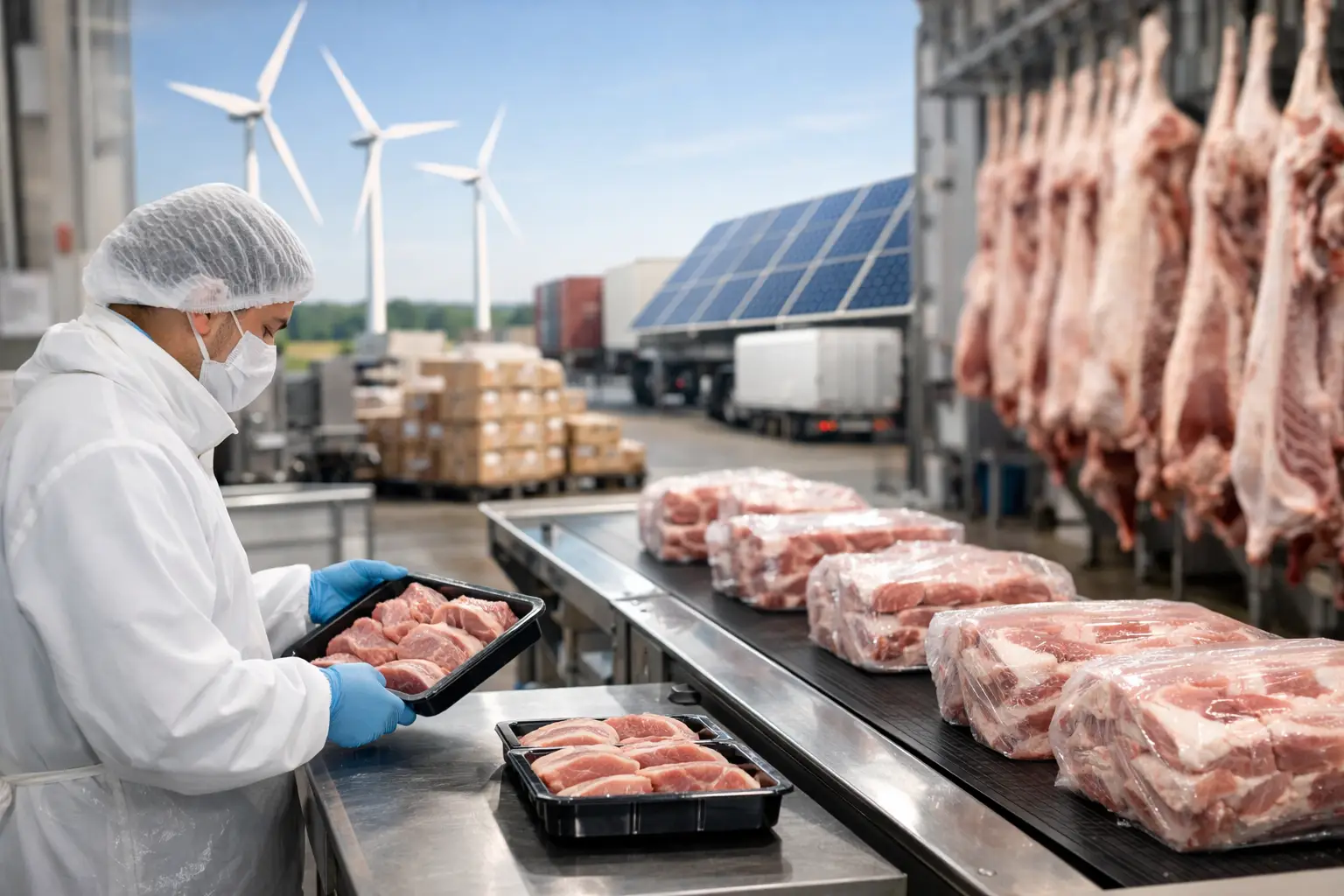
A pork-processing facility does not stop consuming energy when the production shift ends. Refrigeration, freezing, ventilation, wastewater treatment, compressed air, sanitation systems, and cold storage operate continuously or on demanding schedules. For international buyers, renewable energy in meat processing is therefore more than a corporate sustainability statement. It is one indicator of how a supplier manages operating risk, production continuity, and the environmental expectations increasingly present in global procurement.
For high-volume pork sourcing, the relevant question is not whether a facility uses a single renewable technology. Buyers should assess whether energy planning is integrated into a controlled production system that protects food safety, cold-chain performance, traceability, and delivery reliability.
Why energy matters in pork processing
Meat processing is energy-intensive by design. Fresh pork must be handled within controlled temperature ranges from slaughter through cutting, packaging, storage, and dispatch. Freezing adds further demand, while hot-water systems, cleaning operations, air handling, lighting, and automated equipment require reliable electricity and thermal energy.
Energy costs can be material, but the operational consequences of poor energy management are more significant. An interruption to refrigeration can put product integrity at risk. Unstable utility supply can affect production schedules, storage capacity, and loading plans. For buyers managing inventory across long international supply chains, these risks can translate into delayed shipments, reduced flexibility, or avoidable product loss.
Renewable generation can help a processor diversify part of its energy supply and reduce exposure to volatile energy markets. However, it does not replace the need for dependable grid connections, backup systems, preventive maintenance, and disciplined cold-chain controls. The strongest approach combines renewable sources with resilient infrastructure and measurable operational management.
Renewable energy in meat processing: the main options
The appropriate technology depends on a plant’s location, energy profile, available space, local regulations, and access to raw materials. A solution that performs well at one site may not be suitable for another. In meat processing, the most relevant options usually include solar power, biogas, renewable electricity procurement, and energy recovery.
Solar photovoltaic systems
Large industrial roofs and available land can make solar photovoltaic systems practical for some processing sites. Solar production can support daytime electricity demand from lighting, conveyors, ventilation, pumps, offices, and selected processing equipment. It may also contribute to refrigeration demand, although that demand typically continues beyond solar-generation hours.
For buyers, solar capacity alone is not a complete performance measure. More useful questions concern how generation is integrated with plant demand, whether the facility monitors consumption and production, and how it maintains refrigeration and storage during periods without solar output. A professionally managed system treats solar power as one component of an overall energy strategy rather than as a stand-alone solution.
Biogas and organic by-products
Meat-processing operations generate organic material that may be suitable for anaerobic digestion, subject to technical, environmental, and regulatory conditions. Biogas can potentially provide renewable heat, electricity, or fuel after appropriate treatment. It may also support a more circular approach to managing certain waste streams.
This route requires careful control. Feedstock composition, hygiene separation, odor management, digestate handling, permits, and equipment reliability all affect its feasibility. Buyers should not assume that the existence of animal by-products automatically means a facility produces biogas. The practical value lies in a verified, properly managed system with clear environmental controls.
Renewable electricity purchasing
Not every facility can generate significant energy on site. Processors may instead obtain renewable electricity through supply contracts or other market mechanisms available in their jurisdiction. This can be particularly relevant for facilities with limited space, complex building layouts, or high energy requirements that exceed practical on-site generation.
For procurement teams, clarity matters. A supplier should distinguish between physical on-site generation, purchased renewable electricity, and broader emissions-accounting claims. Each may support environmental objectives, but they are not interchangeable from an operational or reporting perspective.
Heat recovery and efficiency measures
The renewable-energy discussion should also include energy efficiency. Recovering heat from refrigeration systems, optimizing compressors, improving insulation, controlling defrost cycles, and monitoring compressed-air losses can reduce total energy demand. Lower consumption allows renewable generation to cover a more meaningful share of a site’s requirements.
These measures may be less visible than solar panels, but they often demonstrate stronger operational discipline. In a facility where refrigeration is central to product safety, efficient equipment management supports both environmental performance and stable processing conditions.
What international pork buyers should evaluate
Energy practices should be assessed as part of supplier qualification, not as an isolated marketing claim. A responsible sourcing review should consider the connection between energy management and core operational controls.
First, examine the supplier’s cold-chain capability. Ask how temperatures are monitored across chilling, cutting, packaging, frozen storage, and loading. Understand the alarm systems, backup arrangements, maintenance procedures, and response process for equipment deviations. Renewable energy is valuable only when it supports, rather than compromises, these essential safeguards.
Second, request clear information on the scope of renewable-energy claims. Does the supplier operate on-site generation? Is renewable electricity purchased? Are the figures based on total facility consumption, a defined production area, or selected operations? Specific boundaries prevent misunderstandings when buyers report supply-chain data to customers, retailers, or authorities.
Third, look for evidence of continuous measurement. Industrial processors should be able to track energy use, identify high-demand equipment, and improve performance over time. Consumption per unit of output can be useful internally, although comparisons between plants require context. Product mix, operating hours, climate, freezing capacity, and facility age all influence energy intensity.
Finally, place energy within the broader compliance framework. Food safety, animal welfare, worker safety, wastewater management, traceability, and export documentation remain fundamental. Environmental progress is most credible when it is managed alongside these established controls, with accountable teams and documented procedures.
Scale changes the energy conversation
At industrial scale, small efficiency gains can have substantial effects. A modest reduction in refrigeration demand, heat loss, or compressed-air consumption can become meaningful when applied across continuous operations and large storage volumes. At the same time, large facilities require sophisticated planning because changes to energy systems cannot interrupt hygiene routines, production flow, or product segregation.
This is especially relevant for export-oriented pork suppliers serving customers with different order formats, specifications, and destination requirements. Fresh and frozen pork cuts, offal, and packaged products may follow distinct handling and storage paths. Energy projects must be designed around these realities, including peak-season volumes and loading schedules.
Litera Meat operates from Binéfar, Spain, as part of an integrated pork-processing platform covering slaughter, cutting, cold-chain handling, packaging, quality control, and commercial distribution. Its scale, including 22 cutting lines and the processing of 160,000 pigs weekly, illustrates why environmental initiatives in modern meat processing must work within tightly controlled industrial operations. Energy planning has practical value when it supports the same objectives buyers expect from a major supplier: consistent product handling, traceability, food safety, and dependable supply.
From environmental commitment to procurement value
Buyers increasingly face sustainability questionnaires, customer reporting requests, and internal targets related to supply-chain emissions. Renewable energy can help provide relevant information, but procurement decisions should remain evidence-based. A supplier’s environmental profile should be reviewed with the same care applied to product specifications, veterinary approvals, laboratory controls, and logistics capability.
It also helps to recognize the trade-offs. On-site renewables may require capital investment, permitting, space, and specialist maintenance. Renewable electricity contracts may depend on local market availability. Biogas projects can offer circularity benefits but demand rigorous environmental and technical management. No single model is automatically preferable in every region or facility.
The practical objective is a processor that understands its energy demand, invests responsibly, communicates claims clearly, and protects the conditions that matter most to buyers: safe pork products, controlled temperatures, traceable production, and reliable commercial execution. When discussing a prospective supplier, ask for the operational evidence behind its energy approach. That conversation will often reveal more about long-term capability than a sustainability statement alone.
Browse the frozen pork range from Litera Meat or send us an enquiry.