

Latest News
Choosing a Foodservice Pork Supplier at Scale

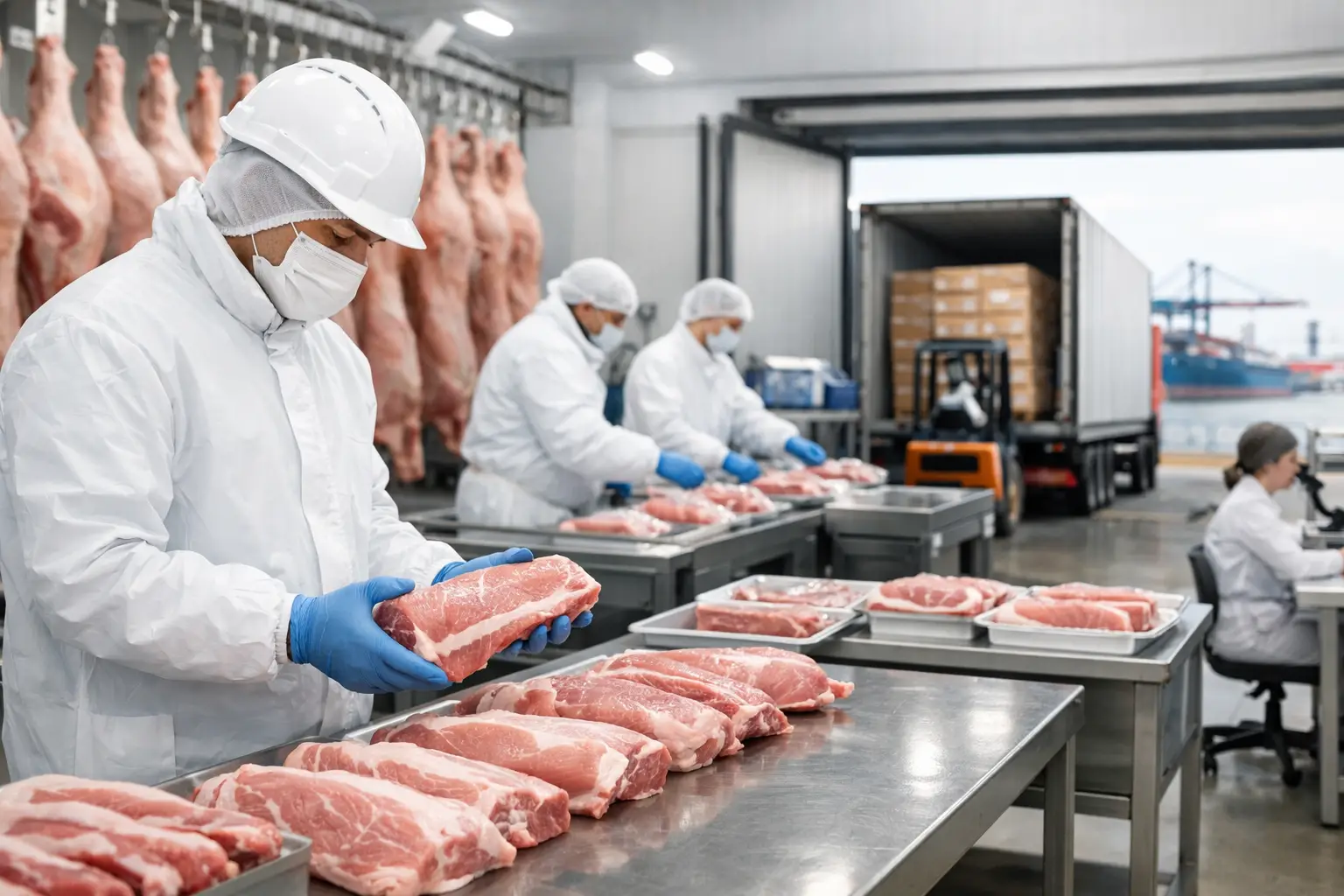
A foodservice pork supplier is not simply a source of raw material. For distributors, processors, retail supply teams, and importers, the supplier becomes part of the operating chain that determines product consistency, delivery performance, menu availability, yield, and food-safety confidence. The right choice depends on more than price per kilogram. It requires a clear view of production capacity, specifications, cold-chain discipline, traceability, and the ability to meet the requirements of the destination market.
For international buyers, this evaluation is especially important. A pork program may involve multiple cuts, frozen and fresh formats, offal, varied pack weights, and long transport routes. Small gaps between the agreed specification and the delivered product can create operational problems well beyond the receiving dock.
What a Foodservice Pork Supplier Must Deliver
Foodservice demand is varied, but it is rarely flexible. A manufacturer may need uniform boneless cuts for further processing. A distributor may need mixed loads of primal cuts and offal for different customer segments. A retailer supplying foodservice clients may require defined labeling, packaging, pallet configuration, and delivery windows.
A capable supplier should therefore begin with a precise commercial specification. This includes the cut definition, trim level, target weight range, fat coverage, bone-in or boneless format, freezing method where applicable, packaging type, shelf-life expectations, and labeling requirements. These details protect both parties from relying on broad product names that can mean different things in different markets.
The same discipline applies to volume. Buyers should distinguish between a supplier that can produce a product occasionally and one that can maintain it as a repeatable commercial program. Reliable supply depends on planned slaughter capacity, cutting-line capability, cold storage, labor availability, packaging capacity, and a commercial team able to coordinate orders across changing demand patterns.
For foodservice buyers, consistency is often more valuable than a short-term price advantage. A standardized loin, belly, shoulder, ham, or rib specification can improve portion control, processing yield, and customer satisfaction. It also reduces the need for costly adjustments at the distributor or manufacturing site.
Capacity Must Be Matched to Product Control
Large-scale production can provide supply security, but scale alone is not enough. The relevant question is whether the operation controls the full process from intake through cutting, packing, storage, and dispatch. When these stages are coordinated within an integrated platform, the supplier has greater ability to manage product flow, respond to forecast changes, and maintain consistent handling conditions.
Buyers should ask how the supplier manages production planning across high-demand periods, including seasonal retail promotions, restaurant recovery cycles, and export peaks. They should also understand what happens when an order changes at short notice. Flexibility has limits in any industrial environment, but clear communication about lead times, minimum order quantities, and substitution options allows both sides to plan realistically.
At Litera Meat, the integrated pork-processing platform in Binéfar, Spain, includes slaughter, cutting, cold-chain handling, packaging, quality control, and commercial distribution. Its facilities cover 130,000 square meters, with 22 cutting lines and capacity to process 160,000 pigs weekly. For buyers evaluating commercial-volume supply, these figures matter because they indicate the operational infrastructure behind a continuing product program rather than a one-off shipment.
That said, a large supplier may not be the ideal fit for every requirement. Smaller or highly specialized orders can require different planning, particularly when they involve uncommon cuts, bespoke packaging, or limited-volume fresh deliveries. The most productive supplier relationship begins with an honest discussion of the required volumes, order frequency, and degree of customization.
Food Safety and Traceability Are Procurement Requirements
Food safety documentation should not be treated as an administrative step completed after the commercial decision. It should be part of the supplier assessment from the outset. A professional pork supplier needs defined controls across raw-material handling, processing hygiene, temperature management, product identification, storage, and dispatch.
Traceability is central to this control. In practical terms, a buyer should be able to understand how the supplier identifies product lots and links them to production records. If an issue is raised at destination, the supplier must be able to investigate efficiently, isolate the relevant batch where necessary, and provide reliable information to the customer and authorities.
An in-house laboratory can add another layer of process control by supporting microbiological and analytical monitoring within the production environment. However, buyers should still review the documentation relevant to their own market and product category. Requirements can differ between fresh chilled pork, frozen pork, processed raw materials, and edible offal.
Before approving a new source, procurement teams should clarify the supplier’s approach to the following operational questions:
- How are lots identified through slaughter, cutting, packaging, and dispatch?
- What temperature controls apply to chilled and frozen product at each stage?
- Which product records, test results, and shipment documents can be provided?
- How are nonconformities, customer complaints, and corrective actions managed?
- What destination-specific approvals and health documentation are available for the intended market?
These questions are not a substitute for the buyer’s own quality procedures. They create a common working framework before product is loaded and shipped.
Fresh, Frozen, Cuts, and Offal Require Different Planning
The choice between chilled and frozen pork has commercial and technical consequences. Fresh chilled pork can support specific customer preferences and shorter supply chains, but it requires exact coordination of production dates, transit times, receiving capacity, and shelf-life management. Frozen pork provides greater planning flexibility and can be more suitable for long-distance distribution, inventory programs, and manufacturing use.
Neither format is automatically better. The decision depends on destination logistics, customer demand, storage capacity, forecast reliability, and the intended use of the product. A buyer supplying hotels and restaurants through a regional distributor may prioritize frequent chilled deliveries. A food manufacturer or importer supplying several markets may benefit from frozen inventory that can be released against demand.
Product range is equally relevant. A broad portfolio of fresh and frozen pork cuts, carcass components, and offal allows buyers to build programs around different commercial channels. Higher-value cuts may serve portioning and retail customers, while shoulders, bellies, trim, and other materials may be directed toward further processing. Offal programs often require their own specifications, packaging formats, and destination-market documentation.
For this reason, buyers should avoid evaluating a supplier on one reference product alone. Review how the supplier handles the full basket of products needed for the program. Consolidating compatible products with one qualified source can simplify purchasing and logistics, provided that specifications and availability are clearly agreed.
Export Readiness Is More Than Shipping Experience
International pork trade involves documentation, market access, transport coordination, and communication across time zones and languages. A supplier may have strong production capability but still create risk if export administration is not aligned with the buyer’s destination requirements.
An export-ready partner understands that documentation must correspond exactly to the shipment, product description, establishment details, and importing-country rules. It also needs commercial teams that can coordinate with freight providers, importers, and inspection points when questions arise.
Buyers should verify destination eligibility for the exact product and market before committing to a supply program. This is particularly important when shipping to markets with specific plant approval requirements or restrictions affecting certain products. Approval status, health certificates, labeling, and import conditions can change, so confirmation should be current rather than based on a previous shipment or general market knowledge.
Spanish origin can be an advantage for buyers seeking access to established European pork production and an export-oriented supply base. Still, origin should be evaluated alongside practical factors: transit route, cold-chain performance, import duty, local distribution capability, and the customer expectations in the final market.
Build the Relationship Around Measurable Performance
A supplier assessment should lead to measurable operating agreements. Product specifications, forecast procedures, lead times, acceptable tolerances, document requirements, and claims processes should be defined before regular deliveries begin. This reduces ambiguity when demand changes or a quality question must be resolved quickly.
The strongest relationships are built through regular performance review rather than assumptions. Buyers and suppliers can examine order fulfillment, specification compliance, temperature records, delivery timing, claims, and forecast accuracy. Where an issue occurs, the priority should be factual investigation and corrective action, not simply assigning blame.
A well-qualified foodservice pork supplier gives procurement teams more than access to product. It provides a controlled production process, credible information, and the capacity to plan beyond the next order. Start with the exact requirements of your customers, test the supplier’s ability to meet them consistently, and build the program on documented performance.
See the products we supply, or get in touch with your requirements.