
Latest News
Pork Grade Comparison for Global Meat Buyers

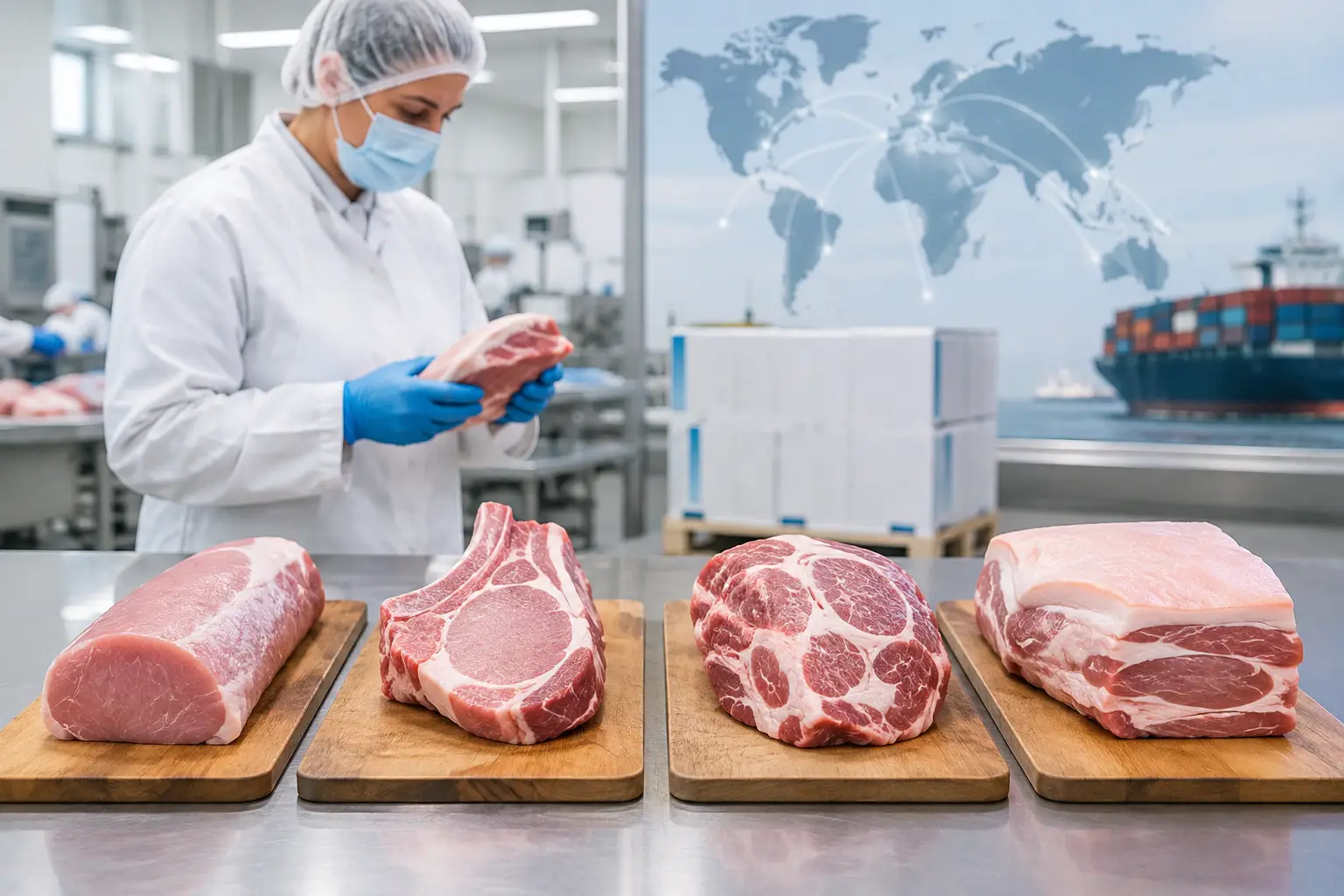
A pork grade comparison can prevent costly misunderstandings between a supplier’s production language and a buyer’s commercial specification. A grade may describe carcass composition in one market, expected retail yield in another, or a locally defined quality category. It does not automatically tell an importer how a boneless loin, belly, ham, or pork offal shipment will perform in processing, retail, or foodservice.
For international procurement, the practical question is not simply which grade is higher. It is whether the classification system, cut specification, inspection status, temperature regime, and documentation match the intended use and the destination market’s requirements.
Why pork grades are not universal
Pork grading systems are established by national or regional authorities, and their purpose varies. Some focus mainly on the proportion of lean meat in a carcass. Others include measures related to muscling, fat cover, and predicted yield. Commercial customers may also use the word “grade” informally to refer to a defined product specification.
This creates a common sourcing risk: comparing grade names as if they were interchangeable across countries. They are not. A carcass classification used in Spain or elsewhere in the European Union cannot be directly converted into a U.S. pork grade or a buyer’s internal product tier without supporting data.
Buyers should therefore treat official grades as one element of an evaluation, not as a complete purchasing specification. The required specification should identify the product in operational terms: cut, presentation, trimming standard, weight range, fat tolerance, packaging, shelf-life requirement, and destination eligibility.
Pork grade comparison: the main systems buyers encounter
European Union carcass classification
In the European Union, including Spain, pig carcasses are commonly classified under the SEUROP system. This system groups carcasses according to estimated lean meat percentage: S represents 60% or more lean meat, followed by E at 55% to less than 60%, U at 50% to less than 55%, R at 45% to less than 50%, O at 40% to less than 45%, and P below 40%.
For an industrial buyer, this classification is useful for understanding the raw-material profile entering a cutting operation. Higher lean categories can support programs that prioritize leaner cuts or controlled fat content. However, a higher lean classification may also mean less fat available for applications where richness, visual marbling, or fat recovery is commercially important.
SEUROP is a carcass-level measure. It does not guarantee that every resulting cut will meet a particular buyer specification. Cutting yield, anatomy, trimming decisions, and product destination still determine the final commercial outcome.
U.S. pork grades
The United States has voluntary USDA pork grades, including U.S. No. 1 through U.S. No. 4. These grades are designed to indicate differences in expected yield of closely trimmed retail cuts, using factors such as muscling and backfat. They should not be read as a universal measure of eating quality or food safety.
For buyers comparing U.S. and European offers, the key distinction is that U.S. grades and EU lean-meat classes were developed within different commercial and regulatory contexts. A supplier should provide the underlying product specification rather than relying on a grade label alone to establish equivalence.
Private and customer-specific specifications
Many international transactions are governed primarily by private specifications. A retailer may require a loin with a defined fat cap and net weight. A processor may need shoulder meat within a narrow visual-fat range. A food manufacturer may prioritize precise chemical lean, controlled particle size after processing, or a consistent frozen block format.
These requirements can be more relevant than an official carcass class because they directly describe the product being purchased. They are also easier to verify through agreed inspection procedures, photographs or diagrams, retained samples, and batch documentation.
What a grade does and does not tell you
An official grade can provide a standardized indication of carcass composition, but it does not replace product-level controls. It normally does not establish the following commercial details:
- Exact primal or subprimal cut definition
- Boneless or bone-in presentation
- Trim level and external fat tolerance
- Individual piece or carton weight range
- Color, pH, and water-holding characteristics
- Fresh or frozen temperature requirements
- Microbiological criteria and testing plan
- Market-access approval for the destination country
These factors matter because pork is bought for a specific outcome. A distributor may need consistent cartons for wholesale customers. A manufacturer may need predictable fat ratios and supply continuity. A retailer may need portion control, visual consistency, and remaining shelf life at delivery. A carcass grade alone cannot answer all of these needs.
Build the specification around the intended application
The right specification begins with the customer’s use case. For fresh retail programs, buyers often focus on appearance, weight uniformity, trim, packaging format, and chilled shelf life. For further processing, the priority may shift toward lean-to-fat balance, functional performance, microbiological controls, and frozen storage stability.
Belly is a useful example. Lean percentage at carcass level provides some context, but it does not define the thickness, layering, skin status, rib configuration, or fat distribution required for bacon, foodservice, or further processing. Similarly, a ham program may require strict weight bands and specific rind or shank presentation that are independent of the carcass’s classification.
Offal requires equally precise language. A buyer of livers, hearts, kidneys, tongues, or heads should define presentation, cleaning standard, freezing method, carton configuration, labeling, and any destination-specific veterinary conditions. These products are often subject to different market preferences and import conditions than muscle cuts.
Verify grade claims through production controls
A reliable supplier should be able to explain how classification and commercial specifications are controlled in practice. This includes the point at which carcasses are classified, how lots are segregated when necessary, how cutting instructions are communicated, and how finished products are checked before dispatch.
For procurement teams, the most useful evidence is usually operational rather than promotional. Request a current product specification, tolerance table, packaging description, labeling example, temperature records, and traceability format. Clarify whether weight refers to individual pieces, cartons, or declared net weight after glazing where frozen products are involved.
Traceability is especially important when grade-related attributes are tied to a supply program. The supplier should be able to connect a shipment to production dates, slaughter batches, cutting batches, and relevant quality-control records. This supports complaint investigation, stock management, and regulatory response if an issue arises.
Consider grade alongside food safety and export eligibility
A favorable classification does not demonstrate compliance with destination requirements. Importers must separately confirm veterinary certification, establishment approval, labeling rules, residue-control expectations, and any conditions for chilled or frozen pork in the receiving market.
This is particularly relevant for companies supplying multiple regions. The same physical cut may require different labels, documentation, carton marks, or shelf-life management for customers in the European Union, Asia, or other export destinations. Procurement planning should involve quality, logistics, and regulatory teams early, rather than treating grade selection as a stand-alone commercial decision.
At Litera Meat, integrated slaughtering, cutting, cold-chain handling, packaging, laboratory capability, and traceability are designed to support this type of controlled supply process. For buyers, the value lies in aligning the agreed product specification with repeatable production controls and the requirements of the final market.
Questions to settle before approving a supplier
Before placing a regular order, ask the supplier which official classification system applies and whether it is relevant to the requested cut. Then confirm the finished-product tolerances in writing. A clear agreement should cover fat and trim expectations, weight bands, packaging, storage temperature, shelf life, inspection method, and procedures for non-conforming product.
It is also sensible to discuss volume planning. A narrowly defined grade or trim requirement can affect raw-material availability, yield, and price. The most restrictive specification is not always the most efficient one. In some cases, a slightly wider tolerance can improve continuity of supply without affecting the buyer’s finished product.
The strongest purchasing decision comes from matching the grade system to a detailed, measurable cut specification. When buyers define what they need at product level and verify the supplier’s control points, pork grades become useful commercial information rather than a source of uncertainty.
Browse the frozen pork range from Litera Meat or send us an enquiry.