
Latest News
European Pork Certifications: What Buyers Need

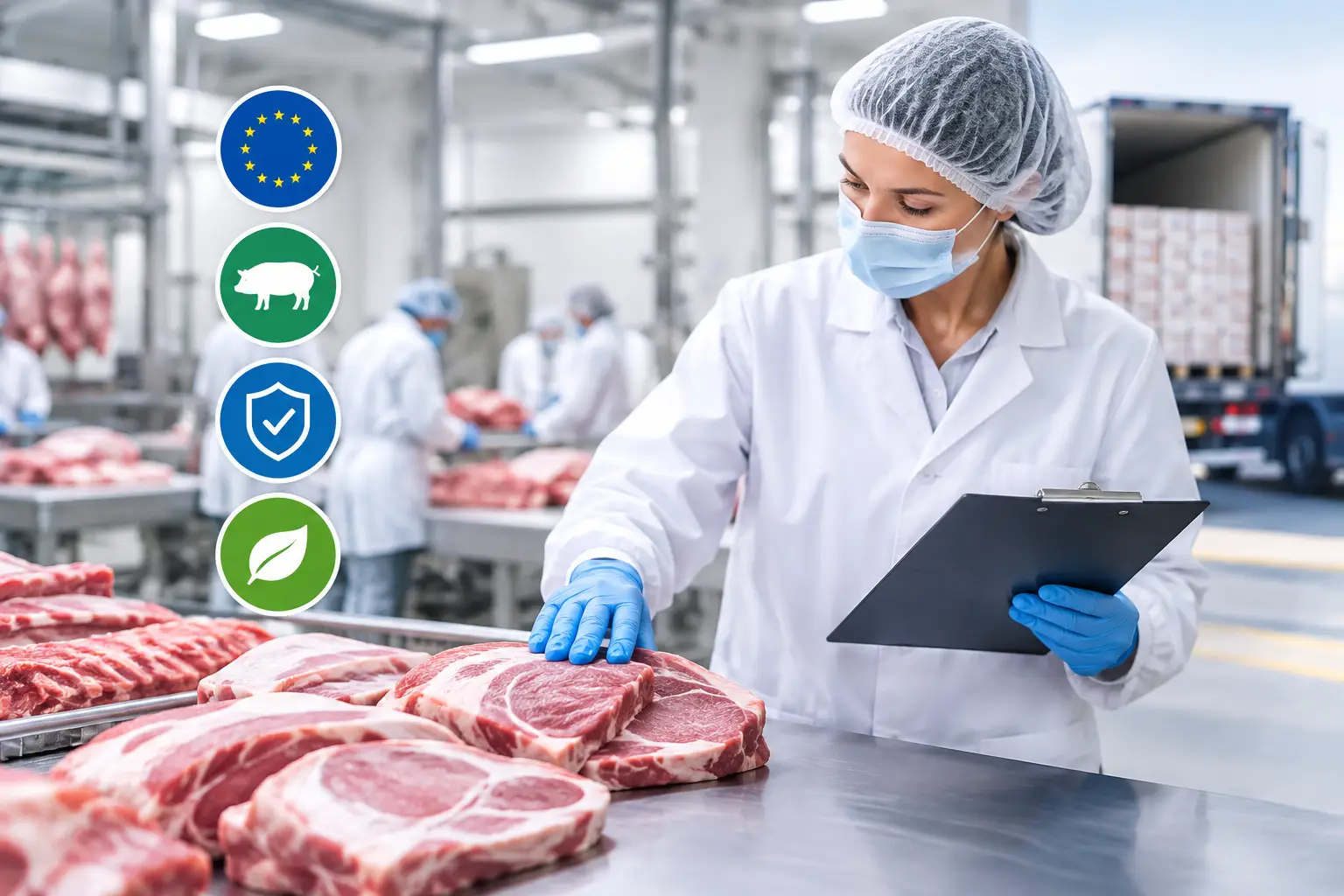
A pork shipment can meet the commercial specification and still fail a buyer’s approval process if its documentation does not match the destination, product use, or customer standard. European pork certifications are therefore not simply labels on a supplier profile. For importers, distributors, food manufacturers, and retail purchasing teams, they are part of the evidence used to assess whether a supplier can deliver safe, traceable, and compliant product consistently.
For pork sourced from Spain and other EU member states, the starting point is the European regulatory framework. Beyond that baseline, individual plants may hold voluntary certification against recognized food-safety, quality, animal-welfare, environmental, or organic standards. The right combination depends on the market, the customer’s risk policy, and the intended use of the pork.
European Pork Certifications: Start With the Legal Baseline
EU legislation establishes mandatory requirements for food hygiene, animal health, animal welfare, traceability, official controls, labeling, and the transport of products of animal origin. These requirements apply throughout the production chain, from farm records and animal identification through slaughter, cutting, packing, storage, and dispatch.
A key point for buyers is that regulatory compliance and voluntary certification are not the same. All approved EU pork establishments must operate under official veterinary supervision and applicable legal controls. A private certification scheme can provide an additional, independently audited management framework, but it does not replace official approval.
For fresh pork, the health mark is one of the most useful pieces of regulatory evidence. It identifies the approved establishment responsible for production and confirms that the product was produced under the relevant EU official-control system. Buyers should ensure that the establishment number on product labels, export documents, and supplier records is consistent.
Traceability is equally central. EU food businesses must be able to identify their suppliers and customers, but commercial buyers often require more detailed traceability. Depending on the product and customer specification, this may include lot identification, production dates, slaughter dates, cutting dates, packaging dates, storage conditions, and pallet-level records. The appropriate level of detail depends on the supply model, especially when products are supplied for further processing or distributed across multiple markets.
The Main Certification Categories Buyers Will Encounter
Food safety and quality management
Food-safety certifications are frequently the first voluntary standards reviewed during supplier approval. BRCGS, IFS Food, FSSC 22000, and ISO 22000 are among the schemes commonly encountered in international meat procurement. Each takes a different approach, but all focus on structured food-safety management, hazard control, hygiene, documentation, corrective action, internal verification, and continual improvement.
BRCGS and IFS Food are widely requested by retail, private-label, and distribution customers. Their audits typically examine practical controls in detail, including foreign-material management, sanitation, allergen control where applicable, supplier management, product specifications, and traceability exercises. FSSC 22000 and ISO 22000 are management-system standards that can be especially relevant for food manufacturers and complex supply chains.
A certificate name alone is not enough. Procurement teams should verify the certified site, the certificate scope, the audit date, the issuing certification body, and any exclusions. A certificate covering a cutting and packaging operation, for example, does not automatically cover a separate cold store, slaughterhouse, or processed-meat facility.
Animal welfare
Animal welfare has become a more formal sourcing requirement in many pork markets. The EU sets legal rules for the protection of pigs on farms and for animal welfare during transport and slaughter. However, customers may require additional welfare programs, retailer protocols, or third-party audits that go beyond legal minimums.
The relevant evidence depends on the buyer’s policy. A foodservice customer may focus on transport times, handling procedures, staff training, lairage conditions, and stunning controls. A retailer may also require farm-level criteria related to housing, environmental enrichment, antibiotic-use policies, or tail docking. These requirements vary significantly by market and should be written into the purchasing specification rather than assumed from a general welfare statement.
For buyers, the practical question is whether the supplier can connect welfare controls to the supplied product category and production chain. This requires clear records, defined responsibilities, trained personnel, and a process for addressing deviations.
Environmental and sustainability standards
Environmental certification can support a buyer’s supplier-assessment program, particularly where carbon reporting, water management, waste reduction, energy use, or packaging are part of the sourcing policy. ISO 14001 is a recognized environmental management standard, while other programs may focus on carbon footprint measurement, responsible soy, renewable energy, or farm sustainability.
These credentials should be evaluated carefully. Environmental certification normally confirms that a management system exists and is audited; it does not by itself establish a specific emissions level or guarantee a particular environmental outcome. Buyers seeking measurable data should request the methodology, organizational boundary, reporting period, and whether figures have been independently verified.
For industrial pork suppliers, environmental performance must be considered across the operating model: livestock supply, water use, refrigeration, by-product handling, wastewater treatment, energy consumption, packaging, and transport. A meaningful evaluation looks beyond a single claim or certificate.
Organic, origin, and specialty schemes
Organic pork requires compliance with specific production and certification rules covering feed, animal management, veterinary treatments, segregation, processing, and labeling. It is not interchangeable with conventional pork produced under high food-safety standards. Buyers should confirm that the organic certificate covers the relevant product, facility, and chain of custody.
Protected Designation of Origin and Protected Geographical Indication schemes may also apply to particular European meat products. These designations are origin and specification systems, not broad food-safety certifications. They can add commercial value where provenance is important, but they are usually relevant only to defined regional products and approved production methods.
Export Approval Is Different From Certification
For international trade, plant approval for the destination market can be as important as a food-safety certificate. Countries may require establishment listing, health certification, agreed veterinary protocols, specific residue-control conditions, labeling formats, or product restrictions. Requirements can differ between fresh, frozen, chilled, bone-in, boneless, and offal products.
This distinction matters for buyers importing into demanding markets across Asia or other regions. A supplier may be fully compliant with EU rules and hold recognized third-party certification, yet not be authorized to export a specific product to a particular destination. Market access must be checked against the current status of the facility and the intended product category before contracts are finalized.
Export documentation also needs to match the transaction. Commercial invoices, packing lists, veterinary health certificates, certificates of origin where required, container-seal information, temperature records, and product labels should be controlled as one documentation set. Small discrepancies can delay customs clearance or create unnecessary claims.
How Procurement Teams Should Assess a Pork Supplier
An effective approval process combines certificates with operational evidence. Start by defining the product clearly: species, cut, trimming specification, fresh or frozen state, packaging format, shelf-life expectation, temperature requirements, and intended market. Then identify the legal and customer-specific requirements that apply.
Request current copies of relevant certificates and verify their scope. Review the supplier’s traceability capability through a documented mock recall or lot-tracing exercise. Ask how quickly the business can identify affected raw material, finished product, customers, and stock in storage. For frozen programs, confirm controls over freezing date, storage temperature, stock rotation, and container loading.
It is also useful to examine the supplier’s quality-control structure. In-house laboratory capability, microbiological monitoring, residue-control programs, sanitation verification, and foreign-body prevention can all be relevant, but the appropriate evidence depends on the risk profile of the product. Fresh pork for retail, frozen raw material for manufacturing, and edible offal for export each require a different technical discussion.
Scale should be assessed alongside control. Large-volume operations can provide continuity, standardized specifications, and dependable supply, provided that production data, segregation, temperature management, and release procedures are maintained across the facility. Litera Meat’s integrated platform in Binéfar combines slaughter, cutting, cold-chain handling, packaging, quality control, and commercial distribution, illustrating why buyers should assess controls across the full process rather than reviewing one department in isolation.
Questions That Prevent Documentation Gaps
Before approving a supplier, buyers should establish which documents are required at order stage, pre-shipment stage, and arrival stage. They should also agree on who is responsible for approving artwork, labels, certificates, and specification changes.
Three questions are particularly useful: Does the certification cover the exact site and activity used for this order? Is the establishment approved for this product and destination? Can the supplier provide traceability and temperature evidence for the specific lot shipped? Clear answers reduce the risk of treating certificates as generic sales documents rather than operational controls.
The strongest sourcing programs use European pork certifications as one part of a wider qualification process. When certificates, official approvals, product specifications, traceability records, and export documents all align, buyers have a more reliable basis for building long-term pork supply relationships.