
Latest News
Pork Processing Innovation Buyers Can Verify

A pork supplier’s technology matters only when it improves a buyer’s ability to source consistently, manage risk, and meet a defined market specification. Pork processing innovation is therefore not simply about faster equipment or more automation. For importers, distributors, food manufacturers, and retail purchasing teams, it is the practical connection between controlled production, reliable documentation, accurate order fulfillment, and product condition on arrival.
For international procurement, this distinction is significant. A modern plant may process large volumes, but scale alone does not guarantee the correct cut, packing format, shelf-life management, or traceability records for a destination market. The most useful innovation is built into the full operating system: from animal reception and slaughter through cutting, chilling, packaging, laboratory controls, storage, and export dispatch.
What pork processing innovation means in procurement
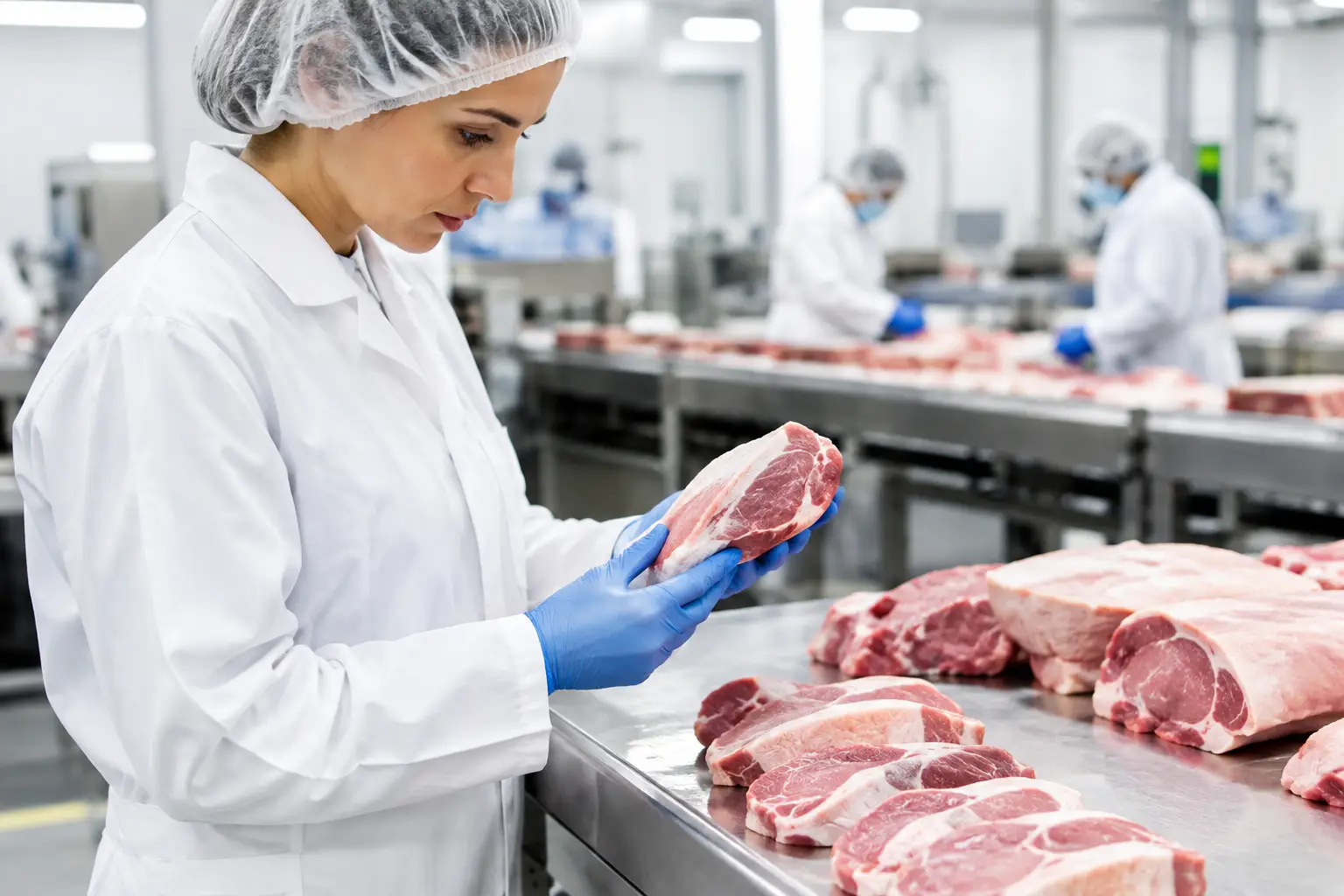
In an industrial setting, innovation should be evaluated as a set of connected capabilities rather than a single piece of machinery. Automated handling and cutting systems can support repeatable yields and specifications. Digital production records can connect lots, processing times, packaging data, and dispatch information. Temperature monitoring can provide greater control through the cold chain. In-house scientific analysis can strengthen verification before product enters commercial channels.
Each capability has a direct purchasing implication. Better cut consistency helps food manufacturers control portioning and formulation. More precise weight and labeling controls support retail and distribution requirements. Traceable lot data helps buyers respond quickly if a quality question arises. Controlled chilling, storage, and loading procedures help preserve product condition during long-distance transport.
The goal is not to remove skilled judgment from production. Pork processing remains a process in which trained people, maintenance discipline, hygiene procedures, and quality teams are essential. Technology is most effective when it gives those teams timely information and repeatable operating conditions.
Scale changes the value of process control
At high production volumes, small variations can become commercially meaningful. A minor inconsistency in trimming, grading, packaging, or temperature management can affect a large number of cartons and create downstream cost for a buyer. This is why large-scale processors need systems that standardize critical stages while allowing commercial specifications to be managed carefully.
For a buyer, the relevant questions are practical: How are product lots identified? How is product held and released? How are weights and labels checked? What controls apply between cutting, packaging, cold storage, and loading? How can a supplier provide the documentation needed for an import program?
The answers should be clear, specific, and linked to real production procedures rather than broad statements about technology.
Where innovation has the greatest impact
Traceability from origin to shipment
Traceability is often discussed as a compliance requirement, but it is also a commercial tool. An effective traceability system allows a processor to identify the history of a product lot and relate it to production and shipping records. For buyers, this supports inventory management, customer communication, and faster investigation when an issue needs review.
The required level of detail depends on the destination market and product application. A retailer may need precise labeling and shelf-life data. A manufacturer may focus on lot integrity, fat specification, or microbiological controls. An importer may need documents that align with veterinary, customs, and market-access requirements. A capable supplier should understand that these needs are connected, not separate administrative tasks.
Cutting accuracy and product specification
Pork is sold in a wide range of commercial formats, including fresh and frozen cuts, boneless products, bone-in cuts, and offal. Innovation in cutting and sorting can improve repeatability in weight ranges, trimming standards, and presentation. This makes planning easier for buyers that distribute product across several customer segments.
However, a highly standardized operation is not automatically the right fit for every order. Specifications may vary by market, customer channel, packaging format, and intended use. The procurement discussion should establish the required cut description, acceptable weight range, fat level where relevant, packaging configuration, pallet pattern, and temperature condition before production is scheduled.
Clear specifications reduce claims more effectively than general quality language. They also give both buyer and supplier a practical basis for checking performance over time.
Cold-chain management and packaging
Fresh pork requires disciplined temperature control from processing through delivery. Frozen pork requires equally careful control of freezing, storage, loading, and transport. Innovation can include integrated monitoring, controlled storage systems, and production planning that reduces unnecessary handling and waiting time.
Packaging decisions are part of that system. Vacuum-packed, tray-packed, bulk-packed, and carton-packed products serve different distribution models. The correct solution depends on whether the product will be sold through retail, foodservice, manufacturing, or wholesale channels, as well as the expected transport duration and local handling capacity.
Buyers should assess packaging as an operational requirement, not a final presentation step. Carton strength, label clarity, pallet stability, product protection, and loading configuration can all influence the condition of a shipment when it reaches a warehouse or distribution center.
Data for quality assurance
A modern quality system relies on evidence. Production data, hygiene verification, laboratory testing, equipment checks, and corrective-action records help a processor identify trends before they develop into wider issues. An in-house laboratory can be particularly valuable because it supports timely testing and closer coordination between operations and quality personnel.
Data does not remove the need for supplier audits or incoming inspection. It does allow buyers to have a more informed conversation about controls, deviations, and preventive actions. The strongest supplier relationships are built when quality teams on both sides can discuss product requirements with shared terminology and documented facts.
How buyers should evaluate a technology-led supplier
When reviewing a pork processor, buyers should look beyond a facilities brochure. Ask how the operation converts technology into consistent delivery. A visit, technical questionnaire, or commercial review should examine the flow of product and information together.
First, consider capacity in relation to the program. Can the supplier support the expected volume without compromising specification management? Second, review the product range and whether fresh, frozen, cuts, and offal can be supplied in the formats required. Third, understand the quality-control structure, including how product is checked, retained, released, and traced. Finally, review export experience for the target destination, because documentation and market approval requirements can materially affect delivery planning.
It is also useful to ask how exceptions are managed. Equipment maintenance, product holds, specification changes, and transport delays are realities of food supply. A supplier’s value is shown not only by routine output, but by how clearly it communicates and acts when conditions change.
Innovation must support responsible production
Technology also has a role in animal welfare, employee safety, resource efficiency, and environmental management. Automated systems can reduce unnecessary handling and improve workplace ergonomics when designed and operated correctly. Monitoring tools can help identify process losses and energy-use opportunities. These improvements are meaningful when they are integrated into daily management rather than treated as separate initiatives.
For international buyers, responsible production increasingly forms part of supplier evaluation. The right approach is evidence-based: understand the policies, operating controls, training, and reporting methods behind a supplier’s commitments. Broad claims should be supported by practices that can be explained and reviewed.
Industrial capability with a Spanish export perspective
Spain is a major European pork-producing and exporting country, making Spanish processors relevant to buyers seeking commercial volumes and diverse product programs. The value of a Spanish supplier depends on more than location. It depends on the ability to coordinate production capacity, quality assurance, cold-chain execution, and export documentation for the destination market.
Litera Meat operates an integrated pork-processing platform in Binéfar, Huesca, covering slaughter, cutting, cold-chain handling, packaging, quality control, and commercial distribution. Its facilities process 160,000 pigs weekly, operate 22 cutting lines, and cover 130,000 square meters. For buyers, integrated capacity can simplify coordination across the stages that determine product consistency and shipment readiness.
The commercial benefit of pork processing innovation is not technology for its own sake. It is a more controllable supply program: defined products, verifiable records, disciplined cold-chain handling, and a supplier that can turn agreed specifications into repeatable export deliveries.